Peta Credlin The Australian 30th January 2025
Is it too easy to become an Australian citizen? Have we let political correctness water down the thorough checks we should be making before we allow someone to call this wide brown land home? Over the break, I’ve been pondering the factors behind the current wave of anti-Semitism. Blatant prejudice is not the sole factor causing mayhem on our streets and driving at least some Jewish people to consider whether they’re still welcome here, but a key element in the current wave of Jew-hating vandalism and firebombing is that newcomers aren’t leaving old hatreds behind them.
Not enough effort is being made to inculcate them into the Australian way of life. And perhaps, there’s too much official tolerance for behaviour that’s intolerant. In 2007, to reassure people concerned about the social cohesion of an increasingly diverse population, the Howard government introduced a citizenship test. At a time when a number of overseas-born Australians of Muslim background had been convicted of terrorism offences, the test was meant to ensure that all migrants understood what was expected of them as Australians. If it ever did weed out people who don’t share our values, it’s certainly not working now, given the scale of ostensibly anti-Israel but effectively anti-Jew protest on our streets. And there’s the real worry that Australian-born descendants of people unwilling to leave hatreds behind are following their parents rather than embracing the values of their homeland.
While it’s certainly possible to disagree with the policy of the Israeli government, it’s not possible to want the destruction of the state of Israel and the expulsion of all Jewish people “from the river to the sea” in ways that are consistent with the Australian values new citizens are supposed to adhere to.
Last year, 183,000 people who want to become Australians did the citizenship test but only 122,000 passed – that’s to say correctly answered 15 of 20 multiple-choice questions about Australia and how we’re governed, including all five questions on Australian values. That fully one in three have failed to pass this ultra-basic test is not only surprising, given the simplicity of the questions; but also disturbing, given the obvious failure of so many Australians, including many recent immigrants, to adhere to the mutual respect and national loyalty that is supposed to be a characteristic of every citizen.
It’s hard to see how anyone who made the citizenship pledge in good faith could have participated, for instance, in the shameful antiSemitic protests outside the Opera House, hardly 24 hours after the October 7 atrocity and long before any self-defence retaliation from Israel. Or consistently attended any of the mosques where hate-preachers have routinely engaged in racial and religious vilification of Jewish people. Even those marching in favour of the restoration to Palestinians of the land that’s now Israel would have to be simple-minded not to grasp that this would inevitably involve a new holocaust. Yet in a manifest failure of the current process, these sentiments are utterly at odds with the officially declared values inherent in Australian citizenship.
Test applicants are provided with a 47-page pamphlet, entitled “Australian Citizenship – Our Common Bond”, that supposedly provides “all the information you need to know to pass”. On page 18, it states “all Australians are expected to treat each other with dignity and respect, regardless of their race, country of origin … heritage, culture … or religion”. And as of last week, the “values” questions in the practice test on the government website included: “Australians believe in freedom of speech. This means: a) people can say what they think about politics; b) men have more legal rights than women; c) everyone must follow a religion”. Plus “in Australia, the use of violence against a person is: a) acceptable if they are a different religion; b) acceptable if they have a different opinion; c) never acceptable and it is against the law”. And “in Australia, we believe in mutual respect and tolerance. This means you can: a) physically fight someone when you disagree with them; b) peacefully disagree with someone; or c) only agree with people from the same religion”.
When fully a third of applicants cannot get right the obvious answers to these almost ridiculously easy questions, we have a massive problem.
Apart from any gulf between applicants’ values and those Australians should be able to take for granted, one explanation could be the primary school tenor of the citizenship pamphlet that sums up Australian history in under two pages; starting with a 65,000-year Indigenous presence, before galloping through the First Fleet, the gold rushes, federation, the 1967 referendum, and post-war migration. Australia Day and Anzac Day between them get as much prominence as do “welcome to country and acknowledgment of country protocols” that, the pamphlet states, are “usually the first item of proceedings to open an event”.
By contrast, the study guide for the Canadian citizenship test has 10 pages of history, including Canada’s constitutional, political and economic development, with some detail on the War of 1812 plus both world wars. The British citizenship guide has 32 pages on the country’s “long and illustrious history” covering in some detail “early Britain”, “the Middle Ages”, “the Tudors and Stuarts”, “a global power”, “the 20th century”, and “Britain since 1945”. The British sample test asks applicants to choose the correct answer to questions such as “when were the last Welsh rebellions defeated?”, “what was the last battle between Great Britain and France?”, “when did women get the vote at the same age as men?”, and “which of these is a British Overseas territory?”. Applicants need only answer 18 of 24 questions correctly, but at least there’s the expectation of a serious engagement with Britain’s past and present.
While most reports suggested the numbers attending this year’s Australia Day protests were well down on previous years, it’s noteworthy that in both Sydney and Melbourne, large protest marches coalesced the usual “invasion day” activists with large numbers demanding that Palestine be free.
Only someone with a lamentable ignorance of history could feel ripped off by modern Australia, but among the epically ignorant, Marxism has coalesced with tribalism. Those claiming British settlement was an act of fundamental injustice have made common cause with those identifying modern Israel with “settler colonialism”, even though it was British settlement that brought democracy, the rule of law, minority rights and scientific progress to Australia’s original inhabitants; and even though Jewish people have been indigenous to Palestine for at least three millenniums, as well as among the greatest contributors to modern Australia.
Much of this profound ignorance is due to the dumbing down and politicisation of history teaching in our schools and universities. But some is the failure of official Australia to expect of all new citizens a reasonable understanding of the history and culture of their new home. Peter Dutton has already pledged, should he be elected, to do whatever the federal government can to end educational indoctrination. No less important, though, would be a strengthened citizenship process that weeds out applicants who’d rather cling to the hatreds of their former homelands than join Team Australia.
Get this right and we’ve got a chance to stop importing hate as well as growing it here; get it wrong, and we won’t recognise our country in a generation’s time, as the experience in parts of the UK and Europe demonstrates.
.
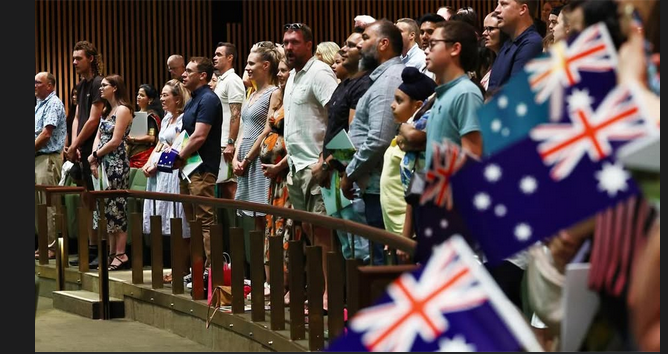
1/ Not enough effort is being made to inculcate some new citizens into the Australian way of life. Picture: Brendan Radke
 Nelle's journey