Caroline Overington The Australian June 6, 2020
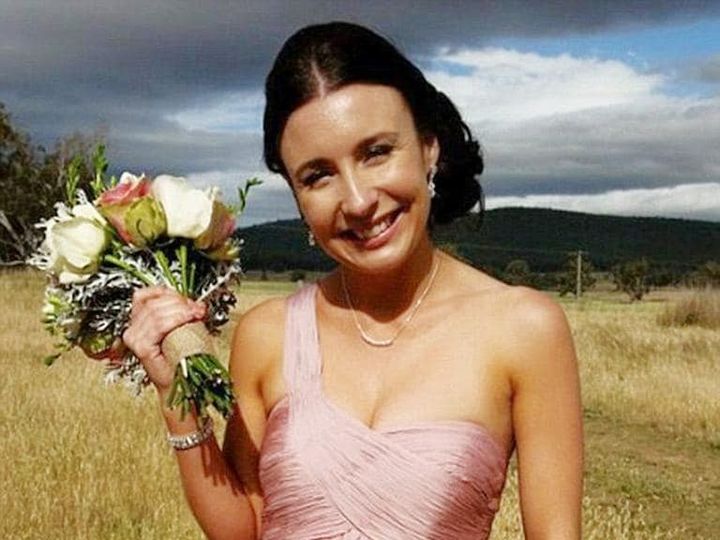
Runaway Bride: that’s probably the headline you recall when thinking about Stephanie Scott, a vivacious high school teacher who disappeared from the rural township of Leeton, in the Riverina region of NSW, a week before her wedding. She’s got cold feet. That’s what some people thought. But not her family and not her devoted fiance. He knew something was terribly wrong. At one point he was even hoping — desperately hoping — that Stephanie had just run off the road in her little red Mazda and that they’d soon find her because her disappearance was so out of character.
It wasn’t to be. Stephanie was murdered on Easter Sunday in 2015, by the school cleaner.
So much of the story was lost at the time, with the focus on Stephanie’s status as a bride-to-be, whose body was found on what should have been her wedding day.
A local journalist, Monique Patterson, has now written an important book, United in Grief, which deals with the impact of such a monstrous crime on a small town.
Stephanie was a beautiful person, well known to many in Leeton through her work at the school. Her killer lived there, too. He was caught too late, meaning after he had taken her life. But his psychological profile strongly suggests he was also just getting started. He had wanted to kill for a long time, and he was just getting the urge again when he was caught.
Patterson, who was the editor of the local paper, the Irrigator, when Stephanie went missing, says Leeton is the kind of place where you get “friendly waves from other motorists” on the road.
Stephanie, who was just 26 when she died, fitted in so well. She had spent her entire life in an even smaller town, Canowindra, a historic township between Orange and Cowra.
It was in Canowindra that she met “the love of her life”, Aaron Leeson-Woolley. As teenagers, they worked at the local IGA together, stealing kisses between the aisles. After high school, Stephanie won a spot at Charles Sturt University in Wagga Wagga, studying teaching. Aaron stayed in Canowindra. Their relationship not only survived, it thrived. On graduating, Stephanie landed a job at Leeton High School. Aaron secured a job at the local meatworks, so they could go together.
Patterson says Stephanie quickly became “the bubbly teacher” who had the kids “in bouts of laughter” during English and drama lessons. Aaron — a quiet and steady young man — proposed to Stephanie during a holiday to Thailand in 2014.
She was, at the time of her death, excitedly planning their wedding, choosing little terracotta pots to adorn with the names of guests, to use as place cards at the reception. They were set to marry on April 11, 2015 — the Saturday after Easter Sunday.
Because she was diligent, and professional, and always thinking of others, Stephanie spent part of Easter Sunday at Leeton High School, preparing a lesson plan for her relief teacher. Her killer, Vincent Stanford, wasn’t supposed to be there. He was a school cleaner who was only supposed to work during the week. He would later tell police he saw Stephanie in the staffroom and the urge to kill her “just came over me”.
She noticed him on her way out to the carpark, saying a cheery goodbye, and “Have a happy Easter”. He pounced as she tried to leave.
“He put his right arm over Stephanie’s mouth and his left arm around her middle,” Patterson writes. “She struggled violently as he walked backwards, dragging her along a corridor to a storeroom.”
Stanford weighed 120kg. He had total control and could easily have pushed her to the floor. But he instead began punching her in the face until she lost consciousness. He raped her, then “removed a 40cm knife from his pocket and stabbed Stephanie in the neck”.
He then returned home, and had a cheese sandwich and a cup of coffee for lunch. He would later return to the school to carry Stephanie’s body out. He tried to stem the bleeding from the wound with yellow masking tape on her neck. He drove her to Cocoparra National Park and set fire to her body.
Locals provided key information, and on Saturday, April 11 — Stephanie and Aaron’s wedding day — Stanford was arrested.
Leeton locals were horrified: the killer had been born in Tasmania, and he had moved to The Netherlands with his mother and his identical twin brother, Marcus, when he was six, but the family had been living in Leeton for about a year. He was not quite a local. But he was known to people.
In her book, Patterson says Stanford “sat calmly with his hands on the table” while talking to police. “He could have easily been at a bank opening a new account — that was how unaffected he appeared by the whole thing,” she writes.
“I had to kill her. I wasn’t angry or anything. I was emotionless — just that I had to kill her,” he said.
Vincent Stanford confesses to the murder of Ms Scott.
Vincent Stanford confesses to the murder of Ms Scott.
But Patterson says police found evidence that suggests Stanford had been thinking about abduction and murder for a long time. He had been stalking a 12-year-old girl. He had 1800 photos of her on his computer, along with an exercise book with notes about her school and ballet schedule.
He also had become obsessed with a young woman who worked at a Leeton supermarket, conducting several computer searches in an attempt to learn more about her. He was also monitoring the movements of one of Stephanie’s colleagues, who often stayed late at school to tidy up and prepare for the next day
A psychologist described him as a “horrifying combination” of callous, cold-blooded and sadistic personality traits. He was sent to prison to await trial. Stephanie’s family and her fiance were left to cope with their grief.
Her sister Kim shared the sweet poem she had intended to read at the wedding:
My little sister, Stephanie Clare Scott,
is now a wedded wife, believe it or not;
They met in Canowindra,
flirting at IGA,
between the creamy pasta salad
and cold meat.
The song the couple intended to play at the wedding — Keith Urban’s Making Memories of Us — had to play at her funeral instead. Leeton businesses closed between 1pm and 2pm as a mark of respect.
Then came a twist: two months after the murder — on June 10, 2015 — police arrested Vincent’s twin brother Marcus.
Vincent had sent Stephanie’s engagement ring and her driver’s licence to him in Adelaide. Marcus had handled and then sold the rings. He also had photographed, then burned, the licence.
There have been cases where identical twins have been able to get away with committing a crime by blaming it on their sibling, since they share the same DNA. We don’t really know what these two were planning. Marcus says he simply had “misplaced loyalty” to his brother when he disposed of the evidence and failed to report a possible crime. He was sentenced to 15 months in prison.
Vincent came to trial in the Supreme Court of NSW in October 2016. Justice Robert Hulme made clear that he was not entirely convinced that Vincent had simply been overcome by a desire to kill.
There was, he said, “a lot more planning and premeditation than he is prepared to admit”.
In February 2015, for example — three months before Stephanie was killed — Vincent searched for “bride rape” and “bride kidnapping” on his computer.
Stanford also had a 40cm knife with him when he went to the school. Stephanie’s DNA had been found on several items at Vincent’s home, including a set of handcuffs.
In prison, he has told psychologists that he “had thoughts of killing someone since the age of 7 or 8 … usually at least once a week, especially when he had to interact with people”.
He said he had not entertained the urge to kill anyone for a couple of months after he killed Stephanie, but “then the same thoughts returned”.
It seems that police interrupted a serial killer. He was going to make a career of this. He had several victims in mind. The judge gave him the only possible sentence: life.
Leeton townsfolk have done their best to try to erase the horror of Stephanie’s murder and celebrate her life. Travel to the township now, and you will find an amphitheatre named for her, where local children sing.
But many were deeply shaken, the author of the book among them.
Patterson stepped down from the editorship of the Irrigator in the wake of the murder. It was simply too awful a crime. When a job came up at The Standard in Warrnambool, which is near where she grew up, she decided to apply, to be closer to family.
“I now have a 20-month-old son who brings me a lot of joy,” she said. But you don’t get over it. Nobody does.
1/ United in Grief, by Monique Patterson.
 Nelle's journey