
Peter O’Brien
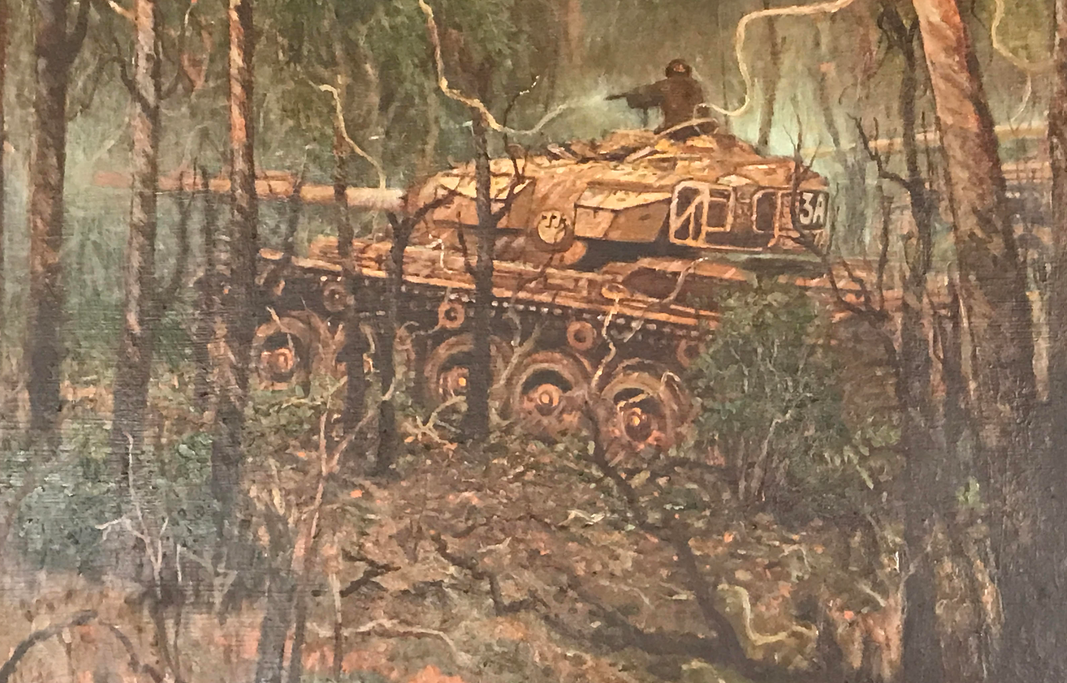
The picture atop this post is a painting of an Australian Army Centurion tank on operations in Phuoc Tuy Province, South Vietnam, in July/August 1971. This was at the Battle of Suoi Ca, in which I was involved. It was not a major battle, but it has some significance in that it was one of the final operations in which Australian tanks were involved in active combat. Not only in South Vietnam, but to this day.
The painter is Kerry Slavin. As a national serviceman he was a crewman in that very tank at that very action. After his discharge from the Army, Kerry studied painting and is now a professional artist.
Kerry gave this painting to my friend Gary McKay, who was also an infantry platoon commander during that action. Gary was severely wounded in the very last battle fought by Australian troops in South Vietnam – the Battle of Nui Le, in which we suffered 5 KIA and 30 WIA. Gary was also awarded the Military Cross for his gallantry in this action – the last awarded to an Australian officer.
Gary offered the painting on permanent loan to the Australian War Memorial, which declined the offer, presumably because they already had two of Kerry Slavin’s paintings in their collection.
I think Gary’s, which now hangs in hall of the Kiama/Jamberoo RSL Sub Branch, is a superior painting which shows the tank as infantrymen saw it in action. It has a more ‘fog of war’ feeling about it. Nonetheless, compare any of Slavin’s paintings with the one below.
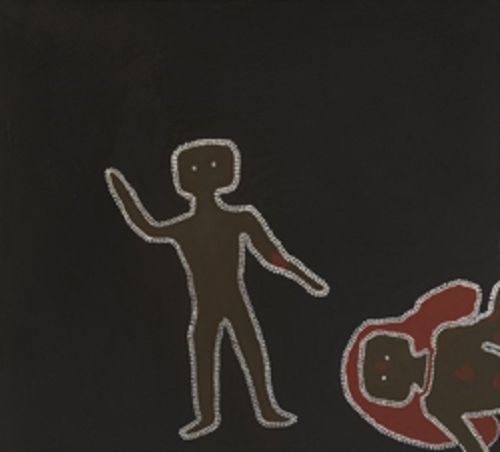
It is described on the AWM website thus:
‘Death of Major at Nine Mile’ was exhibited in Freddie Timms’ solo exhibition at Watter’s Gallery in 1999 which explored the history of the Aboriginal rebel and bush ranger Major, who was shot dead by the Western Australian police in 1908, after killing whites at Blackfella Creek. According to Giga legend, Major was an Aboriginal man, likely Wardaman from Country near Katherine, who at a very young age was bought to Texas Downs, near Warmun, by a man named Jack Kelly. Suffering terrible treatment and abuse as a child, and later after several brutal incidents, he took to the hills north of Turkey Creek, where he held up travelers as a bush ranger. There in the hills he was hunted down by police and killed at a place called Nine Mile, to the east of Warmun.
Before Major was captured and killed, he himself had murdered three white men at Blackfella Creek, which at that time featured a small station settlement that is now part of Lissadell. Major is said to have killed these men in retribution for the terrible murders and the atrocities that had been made against a large number of Gija people at a place called Mistake Creek. Those who survived that massacre, including Timms’ grandmother and her sister, were taken to Blackfella Creek by the white men. After murdering the white men, Major rescued Timms’ grandmother and her sister and took them back to join his party of Gija in the hills.
Major is a hero for the Gija. Timms, for example, grew up learning of Major’s life from his Grandmother who had witnessed his death. Major holds a strong place in Gija history, much like Ned Kelly in European Australian history, but remains an ambiguous hero, as his knowledge of the bush repeatedly led white men to Gija camps, leading to terrible massacres. Timms’ depiction of Major was influenced by his visit to an exhibition of Sydney Nolan’s Ned Kelly series, evident in the squarish shape he gave to Major’s head.
As to the technical merit of this painting, I will leave that to others to judge, not being at all a lover of ‘outsider’ simplistic art. However, I have a real problem with its inclusion in the AWM collection, as it bears no relationship whatsoever to the functions of Memorial which are:
♦ to maintain and develop the national memorial referred to in subsection 6(1) of the Australian War Memorial Act 1962 as a national memorial of Australians who have died:
(i) on or as a result of active service; or
(ii) as a result of any war or warlike operations in which Australians have been on active service;
(b) to develop and maintain, as an integral part of the national memorial referred to in paragraph (a), a national collection of historical material;
(c) to exhibit, or to make available for exhibition by others, historical material from the memorial collection or historical material that is otherwise in the possession of the Memorial;
(d) to conduct, arrange for and assist in research into matters pertaining to Australian military history; and
(e) to disseminate information relating to:
(i) Australian military history
(ii) the national memorial referred to in paragraph (a)
(iii) the memorial collection; and
(iv) the Memorial and its functions.
♦The Memorial shall use every endeavour to make the most advantageous use of the memorial collection in the national interest.
Just to be clear, according to the Act, Australian military history means the history of:
♦ wars and warlike operations in which Australians have been on active service, including the events leading up to, and the aftermath of, such wars and warlike operations; and
♦ the Defence Force.
It is clear from the description of the painting that it relates to the capture and death of a bushranger. It has nothing to do with war or warlike operations. It was a law-and-order matter. Despite his name and the fact that he is described as a ‘rebel’ as well as a bushranger, there is no evidence he conducted any warlike operations against the colonial power. There is even a suggestion, in the above text, that he, at times, aided the colonial power.
As to him killing the three white men at Blackfella Creek ‘in retribution’ for the massacre of a large number of Gija people at Mistake Creek, that is somewhat problematic as Major was killed in 1908, some seven years before the Mistake Creek massacre, which is recorded in the University of Newcastle Massacre Map:
In 1915 Constable John Franklin Flinders reported to Inspector Drewry (who in turn reported it to the Colonial Secretary) that telegraph linesman (and former East Kimberley Policeman) Mick Rhatigan and his two Aboriginal workers, Nipper and Wyne, ‘shot and burned five or six Aborigines’. The ‘charred remains’ of two bodies were found at Mistake Creek and the bodies of five others named ‘Hopples, Nellie, Mona, Gypsy and Nittie’ were found some distance away. (The Advertiser, April 2, 1915, p 8.) This was supposedly in reprisal for allegedly killing Rhatigan’s cow (Owen, 2016, p 438). The Sisters of St Joseph erected a small monument at the foot of the old boab tree at Mistake Creek to mark the place where the massacre occurred (Monument Australia).
So, if that’s his claim to be a rebel, it rests on more than somewhat shaky foundations.
I can’t find any other online reference to Major, so I haven’t been able to confirm the year of his death, but it’s quite possible that the AWM got it wrong, and he was killed not in 1908 but, say, 1918, although the AWM description seems to be quite firm on this point. That would not alter the fact this appears to be a verbal anecdote passed down over a couple of generations. As such, it might pass muster (indeed, no doubt, would) in Albanese’s proposed Truth Telling Commission, but it has no place in a repository of history established, primarily, to honour the Australian Defence Force and the sacrifices of those who served in it.
 Nelle's journey