The Voice saleswoman should not be let anywhere near Yarralumla
Features Australia
Getty Images
11 November 2023
9:00 AM
This edition of The Speccie falls on the 105th anniversary of the end of the first world war. That moment marked the emergence of the fledgling nation of Australia onto the world stage as a force to be reckoned with. The courage, resourcefulness and independence of our diggers had been recognised from an early stage in the war, but it also takes imaginative and courageous leadership to turn these qualities into a winning combination. And that combination was exemplified, not uniquely but primarily, by General Sir John Monash. Today he remains our most distinguished wartime commander and, arguably, the author of our proud military tradition. We would do well, at this time of increasing antisemitism, to remember that Monash was Jewish.
It might be argued that success in war is not an ideal basis for a nation’s international standing, nonetheless we have since burnished that reputation by our evolution into one of the most vigorous democracies in the world with our strict adherence to the rule of law and our willingness to assist those in need, acceptance of refugees, provision of foreign aid or, if necessary, military action.
And this leads me to the real point of this article. Today, the other anniversary we celebrate (and I use the word deliberately) is the withdrawal of Prime Minister Gough Whitlam’s commission by Governor-General Sir John Kerr. This caused a great controversy at the time and Sir John Kerr was mercilessly vilified for the rest of his life, and beyond. I have argued in my book Villain or Victim – a Defence of Sir John Kerr and the Reserve Powers that Kerr acted constitutionally, judiciously and effectively to avert a constitutional crisis. We owe him a debt of gratitude, not only for the immediate resolution of the 1975 crisis, but also for establishing in a practical way, that the governor-general is not a cipher, a mere figurehead.
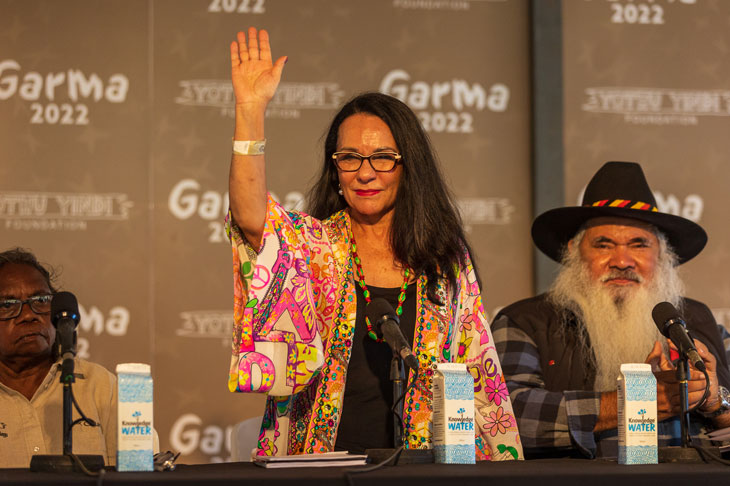
At the time of writing, there is a rumour going around that Minister for Indigenous Australians, the hapless Linda Burney, is being considered to replace General David Hurley as governor-general when he retires next year. What’s not to like about this idea? She’s a woman, she’s Aboriginal, she’s of the left and she has a high profile.
Well, regrettably, that’s all she has to offer. And none of those qualifications are essential, or even necessarily desirable, in a governor-general. The post of governor-general is not a popularity contest.
In fact, it is hard to imagine a worse choice. Not because she is a politician per se. In my lifetime William McKell, Richard Casey, Paul Hasluck and Bill Hayden have all served in that role with distinction.
Firstly, she would be a bad choice because she is a failed politician with a lacklustre record of achievement. Even if the post of governor-general were merely a sinecure, a reward for a lifetime of achievement, Burney would not qualify. But more importantly, she does not understand the constitution. Or if she does, she has shown by embracing implementation of the Uluru Statement in full that her goal is to undermine the constitution and change it in ways that were never envisaged by the founding fathers, or by the 60 per cent of Australian voters who rejected the Voice. One of the main roles of the governor-general is to protect the constitution. The appointment of Burney to this role would match the fecklessness and hubris with which Albo engineered the referendum.
Protection of the constitution is also the preserve of the High Court; the first line of defence. It has the power to disqualify legislation or regulation that is unconstitutional. But only if a matter is seen to be justiciable, i.e. within the purview of the Court. In 1974, Sir John Kerr was asked to sign an Executive Council minute authorising the government to borrow funds without seeking approval from the Loans Council. Kerr thought it was unconstitutional, but he also believed it was justiciable and would ultimately be dealt with by the High Court. So, he signed the minute. As it happened, events intervened, and the loan did not proceed.
In 1975, Kerr was again faced with a proposition that he considered unconstitutional, that the government was proposing to spend money not appropriated by parliament. This too could have been dealt with by the High Court, given time. But Kerr did not have the luxury of time. The money already appropriated would run out, and the government would be unable to pay its bills, before any High Court action could be completed. So, he exercised his reserve power to withdraw the Prime Minister’s commission from Whitlam and give it to Malcolm Fraser on the condition that he pass supply and call a general election. There was no constitutional crisis. There was a political crisis and Kerr solved it by the use of reserve power, which his critics claim had become moribund.
In my book, I argue that the reserve powers exist, and that they are not a vestigial remnant of an archaic system that we inherited, as commentators such as Paul Kelly and Troy Bramston claim. That they were specifically included in our written constitution in 1900 means that they are there for a reason. And the governor-general has a duty to invoke them when called for.
In one sense, ironically, the Crown now acts as the last line of defence of our democracy. One of its functions, probably the critical one, is now to ensure that we, the people, haven’t swapped one tyranny for another. I think of the Crown in Australia as somewhat analogous to the Holy Trinity, albeit with only two members. The King is analogous to God the Father. He is above the fray. The governor-general, analogous to God the Son, not so much so. Insofar as our constitution lets him, the governor-general ‘gets down among the weeds’. Any opprobrium that attends his execution of his duty, stays with him, and does not sully the monarch.
I maintain that one of the duties of the Crown is to protect our individual rights and freedoms, which are not enshrined in the constitution or in a bill of rights. These include the right to life, the right to liberty, the right to property, freedom of religion, freedom of association, equality before the law, freedom of speech and the presumption of innocence. The last two are now routinely being trashed in the Western world and in this country. We live in much more fraught times than we did in 1975 and the doctrine of the separation of powers is coming under increasing stress with the emergence of activist courts; as is our sovereignty, by our increasing and docile acceptance of UN declarations and initiatives.
In making such a key appointment as the governor-general, I believe it is no longer appropriate that the Prime Minister should arbitrarily recommend to the monarch who should represent him in this role. Ideally, a governor-general should be able to boast a substantial record of achievement, be capable of acting apolitically (which would not preclude former politicians but which would, I suggest, require a cooling-off period of at least, say, two years after retirement), have a thorough understanding of our history, of the Westminster system and of our constitution, be a fierce defender of the constitution and have a dispassionate (dare I say, judicial) mindset. But how to find such a person?
The very inkling that Linda Burney might be considered for this post suggests we need a more rigorous process of selection, in which a committee of, for example, cross-party representatives of the legislature and members of the judiciary, can assess suitable candidates and a binding recommendation then be made to the prime minister. This could be done by legislation. It would not require a referendum. And, not to embarrass him, dare I suggest that one eminently suitable candidate appears weekly in these pages, our own Professor David Flint. And even if he were not considered, he certainly provides a template, embodying all those qualities I mentioned above.
 Nelle's journey