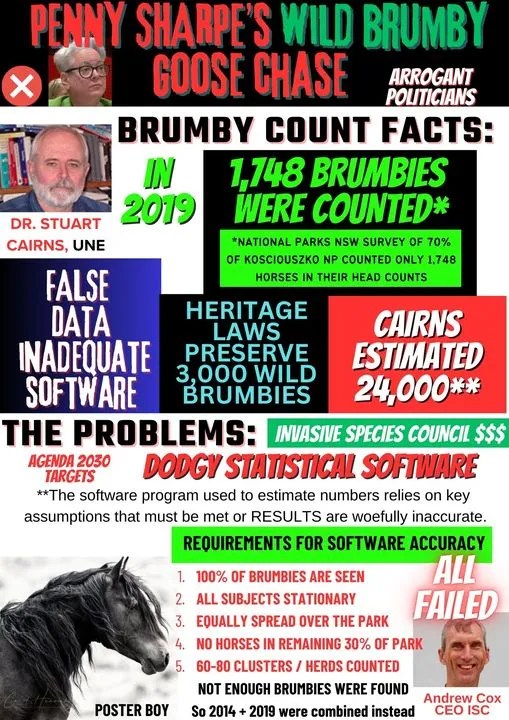
Comment by Nelle-The heritage Law of 2018 in NSW high country preserve 3000 wild horses and at last count by credible counting was 1,748 but according to Dr Cairns a lecturer at UNE and speaking from his desk he estimated around 24,000 and he with the Invasive Species Council together spelled the end of our iconic horses as they took their word and discounted the other contribution as nonsense-this was without any vetting done-the invasive Species council have been wrong on all counts with the brumbies but these hounds also want to wipe out our honey bee-these destroyers of value and traditions of our country know no bounds and it would appear the intend to kill them all
https://www.facebook.com/100000209195873/videos/2065042300502947/


Imported by early settlers, ‘brumbies’ are national symbols for some; for others, they’re just another invasive species that needs to be strictly controlled to protect native species.
By Isabelle Dellerba(Sydney (Australia) correspondent) Published on November 5, 2023, at 2:43 am (Paris), updated on November 5, 2023, at 9:48 am
Time to 3 min. Lire en français
Subscribers only
LETTER FROM SYDNEY
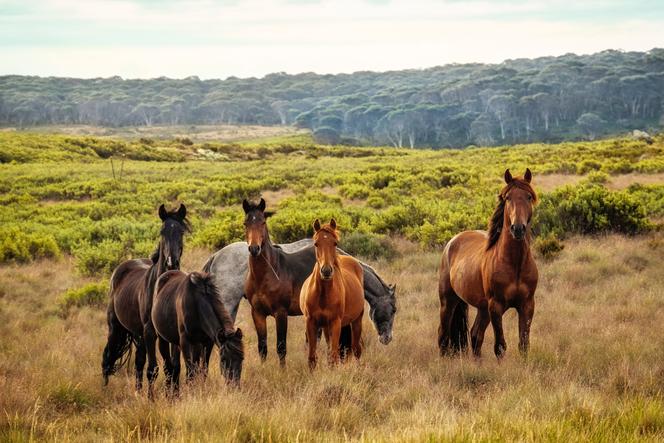
Australia has never held back on using drastic measures to protect its unique ecosystems from exogenous invasive species and even deploys helicopters with professional shooters aboard to eliminate thousands of camels, pigs and deer from the air. The one exception has been Kosciuszko National Park in New South Wales where, despite protests from scientists and conservationists, wild horses, have been relatively protected for the last two decades in the name of cultural heritage.
On Friday, October 27, the local government finally agreed to resume aerial slaughter in order to preserve endemic flora and fauna. But the wild horses, nicknamed “brumbies,” and descendants of the horses that arrived with the first settlers from England in 1788, that were then rewilded – have strong supporters who have no intention of giving up in the culture battle stirring up southeast Australia.
“They deserve better than being left to die an agonizing death,” said Jill Pickering, president of the Australian Alliance for Brumbies, shortly after the announcement. On the organization’s website, she writes that these animals, “iconic” to Australia, and have given their names to “rugby teams, army units, on paper currency (…) [and were] also featured at the opening of the Sydney Olympics.”
‘White man’s imprint on the landscape’
In Kosciuszko National Park, in the Australian Alps 500 kilometers southwest of Sydney, settlers used these horses for transport, rounding up livestock and other tasks essential to life in these remote regions. Brumbies symbolize freedom, independence and tenacity in the face of an often hostile environment, and are part of Australia’s outback mythology. They have been celebrated in local literature and folklore, like in the poem The Man from Snowy River by Banjo Paterson, one of the country’s greatest writers.
“For some, these horses are a reminder of those days when English colonists exploited and enriched themselves from the land. They represent European Australians taming the land. It’s the white man’s imprint on the landscape. The subtitle to my book is The Battle for the soul of Australia (…) This has long been a culture war over symbols of pre- and post-colonial Australia,” said Anthony Sharwood, author of The Brumby Wars (Hachette Australia, 2021).
Before it was colonized, no hard-hoofed animal had ever set foot on the continent, where endemic species such as the kangaroo had paws. The Australian Alps were mainly populated by small animals; the colonizers’ imported animals – cows, sheep and horses – had a deleterious impact on the country’s fragile ecosystems. To protect the environment, the authorities created the Kosciuszko National Park in 1967, one of the largest in the country. But after the ban on aerial slaughter in 2000, the brumby population increased to over 18,000 animals, which have continued to ravage the mountains, trampling watercourses and destroying the habitats of species unique to the area and endangering some of them.
You have 45% of this article left to read. The rest is for subscribers only.
Australia to resume slaughter of wild horses by helicopter to protect wildlife
Current measures are no longer enoughh
Current measures are no longer enough. Australian local authorities approved on Friday October 27 the resumption of the slaughter of wild horses in one of the country’s largest national parks, a measure deemed necessary to protect fauna and flora.
Around 19,000 wild horses, called “brumbies” in Australia, live in Kosciuszko National Park in the southeast of the country. New South Wales state authorities want to reduce this number to 3,000 by mid-2027.
Park officials already eliminate wild horses on the ground with guns or traps, or transfer them elsewhere. But according to New South Wales Environment Minister Penny Sharpe, “native species are facing extinction and the entire ecosystem is under threat” because of excessive numbers of wild horses. “We must act,” said the minister. “It was not an easy decision to make, no one would want to kill wild horses,” said Ms. Sharpe.
Pest animals
Brumbies are considered by authorities to be harmful animals because they increase soil erosion and kill vegetation by grazing or trampling it. They also cause burrows to collapse, compete with other animals for food and shelter and also make water points unsanitary.
The helicopter slaughter method had already been briefly used in 2000. More than 600 wild horses were killed in three days. But local authorities then backed down in the face of public outrage. Opponents of the cull claim horses are part of Australia’s national identity.
Australia has up to 400,000 wild horses, according to the Invasive Species Council, an Australian NGO which welcomed the decision of the state of New South Wales on Friday. The number of brumbies in this Australian state is currently increasing by 15% to 18% per year, much more than the number of horses eliminated by current eradication methods, noted Jack Gough, a spokesperson for this NGO.
comment by NellePeople who have no soul and happily tell lies to get these animals killed, obviously for money- bloody money it should be made obsolete and all our problems would be solved -Heritage laws preserve 3000 wild horses and at last count 1748 were listed
https://www.facebook.com/100004710581770/videos/339015795475874/
How’s pristine for you atticus Fleming, npws,Chris minns,penny Sharpe mlc & of course the bureaucrats….NGARIGO COUNTRY….knp…1 Nov 2023- watch the KNP wasteland made by man not horses and wait for the next bush fire season and keep well away
 Nelle's journey