Appearance
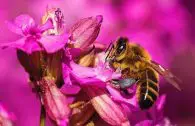
One of the world’s most well known insects, the European honeybee is instantly recognizable to most people. Their body is split in to 3 sections as with all insects, the head, thorax and abdomen. The abdomen is the most recognizable part of the body and is striped with yellow and brown. All parts of the body are covered with hair.
There are 3 castes (sizes) of European honeybee within each hive. The queen is the largest and is the breeding female. Males are called drones and are the second largest. Their abdomen is blunt and flattened on the end. A worker is the smallest European honeybee and is a non-breeding female.
They have 6 legs which have small hairs on them. At the end of each leg is a sharp claw that is used for holding on to flowers.
At the end of the body is the barbed stinger that is used to sting threats. The queens stinger has reduced barbs and this means she will not die if she stings.
European honeybees have 2 wings on their back which is used to fly.
On top of their head are the antennae which are covered with thousands of scent detectors. Also on the head are the compound eyes which are used to see. The eyes of the drone (male bee) are larger than those of females and touch in the middle of the head. At the front of the head is a proboscis, this is a long tube that unrolls to help suck nectar in to their digestive system.
An adult honeybee measures between 1.3 and 1.6cm (0.5-0.6in).
Scientific Name
Apis mellifera
Conservation Status
Not Evaluated
Length
1.3-1.6cm (0.5-0.6in)
Lifespan
Queen – 5 years
Drone – 8 weeks
Worker
6 weeks (summer)
5 months (winter)
Diet
Herbivorous
— AD —
Diet
Honeybees are herbivores and feed on nectar, pollen and the honey they produce. Pollen is fed to the developing larvae.
Honey is produced by workers who regurgitate the nectar they gathered on their flights. This is then fanned till it is dry and produces honey. The honey is used to feed the rest of the colony.
Range
The European honeybee is native to Europe and can also be found in Western and Central Asia, the Middle East and much of Southern Africa.
As a valuable pollinator and a source of honey they have been introduced to every continent except Antarctica.
Habitat
European honeybees require a range of flowering plants to maintain their habitat. This may be natural areas such as a woodland or forest. With their spread for human honey production they are often found in urban areas and backyards.
They form a hive where they live inside of rock crevices, hollow trees and other areas. With the expansion of humans they may form their home in the walls or roofs of houses. The hive is used to store honey which they can eat when they cannot go outside and sustains them through winter.
Reproduction
The queen is the only caste which can lay fertilized eggs though some workers may lay unfertilized eggs.
Young honeybees go through a complete metamorphosis. They start out as an egg which hatches to become a larva. Then they will form a pupa and when they exit this they are an adult.
The length of time it takes for this metamorphosis to occur varies based on the caste the egg will become. Eggs take 3 days to hatch and then a drone will develop in 24 days, a worker in 21 days and a queen in just 15 or 16 days.
Each egg resembles a grain of rice and is deposited in to a individual cell within the brood area of the hive.
Once they hatch in to a larva they are white and spend their time laying at the bottom of their cell in the hive. When it is time for them to pupate their cell is covered by workers with a wax cap. Once they successfully develop in to an adult they will chew their way out of the cap.
Larva are feed pollen and nectar. When the queen dies or leaves the nest one of the larva will be feed ‘royal jelly’ by the workers which provides the nutrition needed to become a queen.
The queen leaves the nest to establish a new nest and this typically takes place in Spring or Summer. Prior to this she will produce 15-20 eggs which will develop in to queens by being fed the royal jelly. The first queen to hatch will kill the other 15-20 queen larva to ensure her place at the top. If multiple hatch at the same time they will fight to the death to become leader of that hive.
Following this the female leaves the hive and mates with up to 15 drones (male bees) storing enough sperm to last her whole life. Mating takes place while in flight. Once this is complete she will begin to lay eggs.
Behaviour
During winter the bees inside of a hive will gather in a cluster to conserve their body heat.
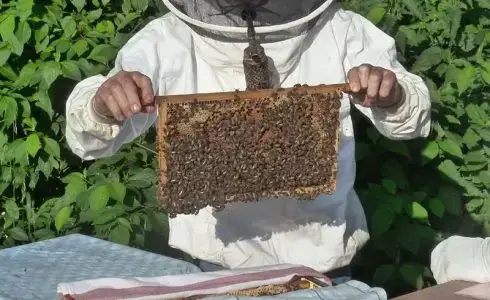
Each beehive is home to the group of honeybees which can be called a swarm or colony. Each colony may be made up of as many as 80,000 honeybees.
Honeybees will aggressively defend their nest with the main method of defense being to sting. This is fatal to the bee as the stinger is left in their victim and rips from their body. This action leaves the venom gland pumping the venom in to the body of their victim for an extended period.
They communicate using pheromones. All members of the colony can produce different pheromones.
To establish new colonies the female will leave her hive and take 2/3 of the current workers with her during spring or summer. A group of workers will have left in advance to find a new hive site and once they arrive they begin to form this new hive.
At the former hive a newly hatched queen will take over and continue the growth of that hive.
Predators and Threats
Due to the movement around the world by humans the European honey bee is susceptible to a wide range of disease and pests that can affect their ability to survive.
The use of pesticides can lead to the death of bees which attempt to fertilize those plants or collect nectar and pollen there.
One of the largest threats is colony collapse disorder in which the majority of workers leave a colony leaving the queen and brood with no one to sustain them. The colony does not show any of the typical signs of colony die out. The cause of this phenomenon is yet to be determined.
Quick facts
European honeybees are one of the world’s most valuable pollinators.
They are the world’s most commonly domesticated bee species.
Photo Credits
Used under license
References
Ambrose, J., 2015. Wildlife Of The World. 1st ed. London: Dorling Kindersley.
National Geographic. 2020. Honeybee. [online] Available at:<https://www.nationalgeographic.com/animals/invertebrates/h/honeybee/> [Accessed 18 July 2020].
The Australian Museum. 2020. Honey Bee. [online] Available at: <https://australian.museum/learn/animals/insects/honey-bee/> [Accessed 18 July 2020].
Gillespie, Claire. “What Is the Life Span of a Honey Bee?” sciencing.com, https://sciencing.com/life-span-honey-bee-6573678.html. [18 July 2020]
Orkin.com. 2020. How Do Honeybees Make Hives? Honey Bee Hive Facts & Dangers Of Hives. [online] Available at:<https://www.orkin.com/stinging-pests/bees/how-do-honeybees-make-hives> [Accessed 18 July 2020].
US EPA. 2020. Colony Collapse Disorder | US EPA. [online] Available at: <https://www.epa.gov/pollinator-protection/colony-collapse-disorder> [Accessed 18 July 2020].
Entnemdept.ufl.edu. 2020. European Honey Bee – Apis Mellifera. [online] Available at:<http://entnemdept.ufl.edu/creatures/MISC/BEES/euro_honey_bee.html> [Accessed 18 July 2020].
See privacy policy.
European honeybee
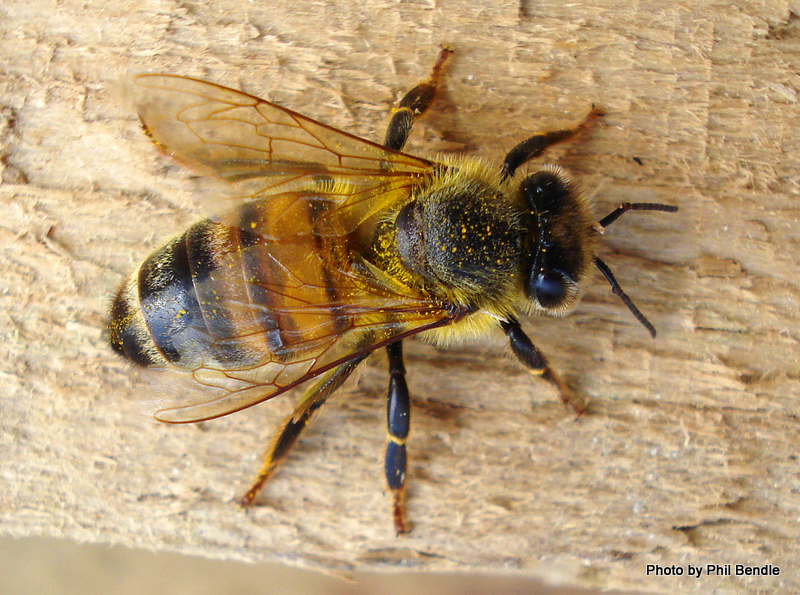
European honey bee (Image: Phil Bendle, T.E.R R.A.I.N, NZ)
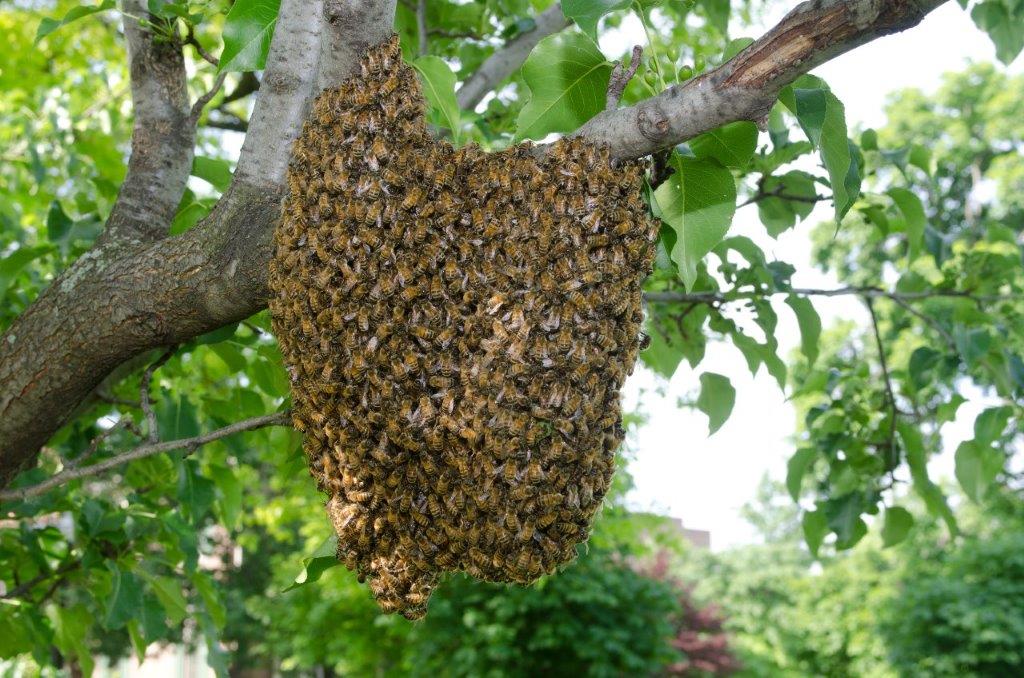
European honey bee swarm (Image: Shutterstock)
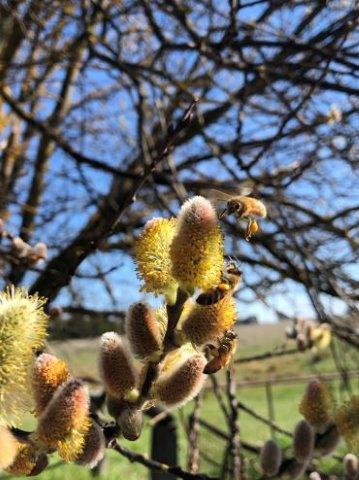
European honey bee foraging (Image: Pip Cotter, NSW DPI)
Apis mellifera
Should I report?
The European honey bee (Apis mellifera) was brought into Australia over 190 years ago. It is the common domestic honey bee found in Australia. This species is not a biosecurity threat. You do not need to report it.
Description
The European honey bee ranges in size from 13-16mm and can vary in colour but are usually seen with yellow abdominal banding and fine visible hairs all over the body. Their antennae are slightly longer than their head and they have light brown wings with dark veins.
European honey bees are a social species and live in colonies of approximately 40,000 to 80,000 bees. Inside their hives they build parallel wax structures to house food storage and their brood and prefer to nest in a cavity such as a hollow tree or house wall.
Swarming can occur once or twice a year depending on a number of factors such as health, climate and floral resources. European honey bees are generally docile with a placid temperament, only stinging when threatened.
Distribution
European honey bees are distributed throughout all of Australia including establishment in Norfolk Island, Lord Howe Island and Kangaroo Island.
Benefits
European honey bees play an important role in large scale agricultural pollination services and provide beeswax and honey to the domestic and export market.

European Honey Bee
Introduced over 180 years ago to pollinate the plants that early settlers used for food, European Honey Bees have become an aggressive species. They are an increasing threat to Australia’s native fauna – including the black cockatoo, small parrots, Sacred Kingfisher, and many small mammals like bats and possums – as they compete against them for dwelling hollows in trees, usually winning by stinging or swarming them. The bees are a particular nuisance in summer, and it has been found that about 3% of Australians are allergic to honey bee venom, which is said to kill up to two Australians every year.
European Honey Bee | © John Severns/WikiCommons
Comment by Nelle- this invasive council needs to go they spread misinformation which the clowns in parks use as their manual- hence the poisoning of bees but they are necessary ‘European honey bees play an important role in large scale agricultural pollination services and provide beeswax and honey to the domestic and export market.’
The slaughter of horses- horses have been part of our nation since first settlement, they have been used by settlers to build this nation, went to war with our soldier boys been the subject of legends in poetry and film -have become our iconic horses loved by Australians- they cause no environmental damage in fact enhance the ecosystems they are not feral but wild
while the absurdity of woke is in control we will see wide spread annihilation of innocent wildlife- for heavens sake they are even taken umbrage at out our bees -will ever enough be enough
Share this:
 Nelle's journey