Qantas was blasted for its “disrespect” during a fiery Senate hearing, which saw the airline repeatedly dodge questions about its support for ‘Yes23’ campaign in the upcoming Voice to Parliament referendum.
Amy LandseyDigital Reporter
A heated fight erupted between Qantas bosses and Senator Bridget McKenzie over the airline’s support for the Yes23 campaign in the upcoming referendum during a tense Senate hearing.
Qantas announced its support for the Yes23 campaign in August by decking out three aircraft with its logo, unveiling the livery at a glitzy event held at Sydney Airport and attended by the Prime Minister.
During an excruciating Senate hearing into bilateral air agreements on Thursday, Senator McKenzie grilled Qantas Chairman Richard Goyder, General Counsel Andrew Finch, and new CEO Vanessa Hudson about the national carrier’s support of Labor’s proposed Voice to Parliament.
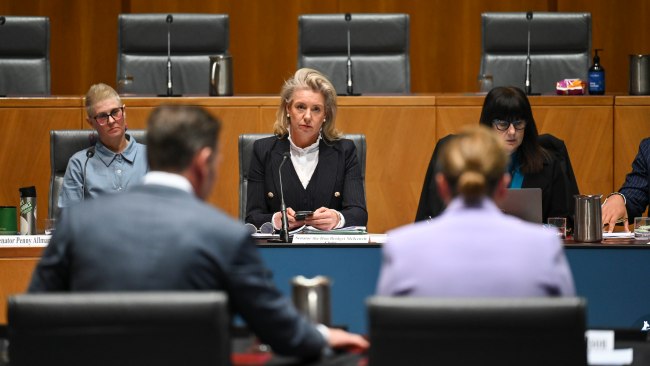
Qantas Chairman Richard Goyder, new CEO of Qantas Airways Vanessa Hudson and Qantas Group’s General Counsel Andrew Finch appeared before an inquiry into Australia’s bilateral airservices arrangements at Parliament House in Canberra. Picture: NCA NewsWire / Martin Ollman
The airline repeatedly dodged questioning on who had authorised the company’s support for the Yes campaign and when the decision was finalised, telling the inquiry they’d have to take the questions on notice.
This prompted an incredulous response from Senator McKenzie, who chairs the Senate Committee on Bilateral Air Agreements.
“Really? Takes time to paint a 737, an Airbus and a Dash 8 turboprop, and find time in the Prime Minister’s diary,” Senator McKenzie said.
Qantas has been a public supporter of the Uluru Statement from the Heart – the framework that guides the Voice to Parliament proposal – since 2019.

Vanessa Hudson made an appearance at the Senate inquiry. Picture: NCA NewsWire / Martin Ollman
The discussion heated up when Senator McKenzie implied there had been a “quid pro quo” between Qantas and Labor, inferring the airline had agreed to support the Voice in exchange for the government’s rejection of the Qatar Airways bid for extra flights.
“It’s quite incredible. This is the whole quid pro quo, and nobody came prepared to answer questions. What a surprise,” she countered.
The airline’s general counsel Andrew Finch took issue with Senator McKenzie’s comment, interrupting to ask her to clarify the remarks about a “quid pro quo”.
“Your suggestion of a quid pro quo,” Mr Finch started. “Can you elaborate on that please?”
A tense back-and-forth between the pair ensued, which culminated in Senator McKenzie calling out the airline for failing to provide a written submission to the inquiry and deliberately avoiding difficult questions.
“Guess what. When you come to a Senate inquiry, we ask the questions and you’re supposed to come with the answers,” she said.
“A bit like failing to hand in a submission, not having details about when you had made significant decisions in partnership with the government just shows the level of disrespect.”

Qantas General Counsel Andrew Finch sparked a fight with the Senate Committee’s chair. Picture: NCA NewsWire / Martin Ollman
Wednesday’s hearing was the last of four public hearings held as part of the Senate Inquiry into Bilateral Air Service Agreements, which was formed in the wake of the Labor government’s decision to block Qatar Airways bid for 21 extra flights in Australia.
The inquiry has heard from major players across the aviation and tourism sectors and has also examined the wider issue of competition in the Australian airline industry.
Former Qantas boss Alan Joyce failed to appear at the inquiry, citing personal reasons. He is believed to be overseas currently.
Virgin Australia CEO Jayne Hrdlicka referred to Qantas as an “800-pound gorilla” in the industry, while former ACCC boss Rod Sims said he would be “stunned” if the airline hadn’t taken advantage of their market power to raise prices.
Several suggestions to improve competition in the airline industry have been floated throughout the two weeks of public hearings; including improving slot allocation at major airports and introducing an open skies agreement.
 Nelle's journey