James Herriot Ethos
All things bright and beautiful,
All creatures great and small,
All things wise and wonderful:
The Lord God made them all.
James Alfred Wight, better known by his pen name James Herriot, was a British veterinary surgeon and author. Born in Sunderland, Wight graduated from Glasgow Veterinary College in 1939, returning to England to become a veterinary surgeon in Yorkshire, where he practised for almost 50 years.


Alf and Joan Wight

Alf with his children Jimmy and Rosie

Donald Sinclair (Seigfried_) Alf Wight and Brain Sinclair (Tristan)
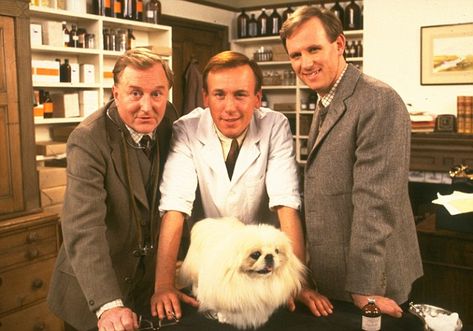
Robert hardy (Seigfried) Christopher Timothy (James Herriot) Peter Davison *Tristan)

James Alfred Wight OBE FRCVS (3 October 1916 – 23 February 1995), better known by his pen name James Herriot, was a British veterinary surgeon and author.
Born in Sunderland, Wight graduated from Glasgow Veterinary College in 1939, returning to England to become a veterinary surgeon in Yorkshire, where he practised for almost 50 years. He is best known for writing a series of eight books set in the 1930s–1950s Yorkshire Dales about veterinary practice, animals, and their owners, which began with If Only They Could Talk, first published in 1970. Over the decades, the series of books has sold some 60 million copies.[1]
The franchise based on his writings was very successful. In addition to the books, there have been several television and film adaptations of Wight’s books, including the 1975 film All Creatures Great and Small; a BBC television series of the same name, which ran 90 episodes; and a 2020 UK Channel 5 series, also of the same name.[2]
Life
James Alfred Wight, who was called “Alf” for short, was born on 3 October 1916 in Sunderland, County Durham, England.[3] Although Wight was born in England, the family moved to Glasgow when James was a child, and he lived there happily until leaving for Sunderland, and then Thirsk in 1940. He had a “soft, lilting Scottish accent,” according to actor Christopher Timothy, who portrayed James Herriot in the 1978 series.[4]
Wight attended Yoker Primary School and Hillhead High School.[5] When he was a boy in Glasgow, one of Wight’s favourite pastimes was walking with his dog, an Irish Setter, in the Scottish countryside and watching it play with his friends’ dogs. He later wrote: “I was intrigued by the character and behaviour of these animals… [I wanted to] spend my life working with them if possible.” At age 12, he read an article in Meccano Magazine about veterinary surgeons and was captivated with the idea of a career treating sick animals. Two years later, in 1930, he decided to become a vet after the principal of Glasgow Veterinary College gave a lecture at his high school.[6]


Wight married Joan Catherine Anderson Danbury on 5 November 1941 at St Mary’s Church, Thirsk.[7]
After they returned to Thirsk, Wight “carried on TB testing [of] cows in Wensleydale and the top floor of 23 Kirkgate became Joan and Alf’s first home”.[5] The couple had two children: James Alexander (born 13 February 1943), who also became a veterinarian and eventually his father’s successor in the practice, and Rosemary (born 9 May 1947), who became a general practitioner.[8]: 148, 169, 292
Veterinary practice
Wight took six years to complete the five-year programme at Glasgow Veterinary College. He failed several of his classes on the first try (surgery, pathology, physiology, histology, animal husbandry). His setback was partly because of a recurring gastrointestinal problem, which required multiple operations.[1] He graduated on 14 December 1939.[5]
The new vet’s first position, which he accepted in January 1940, was at a veterinary practice in Sunderland, working for J. J. McDowall.[5] He decided that he would prefer a rural practice and accepted a position in July, based at 23 Kirkgate in Thirsk, Yorkshire, near the Yorkshire Dales and the North York Moors. The practice owner, Donald Sinclair, had enlisted in the Royal Air Force (RAF) and was soon to leave for training; he gave Wight all the practice’s income in return for Wight’s looking after it during his absence.[9] (His brother, Brian Sinclair, was not yet a vet.) After Sinclair was discharged from the RAF four months later, he asked Wight to stay permanently with the practice, offering a salaried partnership, which Wight accepted.[10]
Wight enlisted in the RAF in November 1942. He did well in his training and was one of the first in his flight to fly solo. After undergoing surgery on an anal fistula in July 1943, he was deemed unfit to fly combat aircraft and was discharged as a leading aircraftman the following November. He joined his wife at her parents’ house, where she had lived since he left Thirsk. They lived there until the summer of 1945, when they moved back to 23 Kirkgate after Sinclair and his wife moved to a house of their own. In 1953, the family moved to a house on Topcliffe Road, Thirsk. Wishing for more privacy as the popularity of All Creatures Great and Small increased, in 1977 Wight and his wife moved again, to the smaller village of Thirlby, about 4 miles (6.4 km) from Thirsk. Wight lived there until his death in 1995.[8]
Wight became a full partner in the Thirsk practice in 1949 and retired from full-time practice in 1980 but continued to work part time.[5] He fully retired in 1989 (or 1990 according to some sources); by then, he had worked in his field for roughly 50 years.[1][5]
Death
In Wight’s will, his share of the practice passed to his son. Wight had been diagnosed with prostate cancer in 1991 and was treated in the Friarage Hospital in Northallerton.[8]: 345, 352 He died on 23 February 1995 at home in Thirlby at age 78,[11] leaving an estate valued for probate at £5,425,873 (equivalent to £11,096,613 in 2021).[12][13] His remains were cremated and scattered on Sutton Bank.[5] His wife’s health declined after his death, and she died on 14 July 1999.[14]
Remembering Alf Wight
In 2001, a book by Wight’s son, Jim, was published. A review of The Real James Herriot: A Memoir of My Father noted, “Wight portrays his father as a modest, down-to-earth and generous man, utterly unchanged by fame, a private individual who bottled up his emotions, which led to a nervous breakdown and electroshock therapy in 1960.”[15]
Wight’s obituary confirmed his modesty and preference to stay away from the public eye. “It doesn’t give me any kick at all,” he once said. “It’s not my world. I wouldn’t be happy there. I wouldn’t give up being a vet if I had a million pounds. I’m too fond of animals.”[16] By 1995, some 50 million of the James Herriot books had been sold. Wight was well aware that clients were unimpressed with the fame that accompanied a best-selling author. “If a farmer calls me with a sick animal, he couldn’t care less if I were George Bernard Shaw,” Wight once said.[17]
Career as an author
Although Wight claimed in the preface of James Herriot’s Yorkshire that he had begun to write only after his wife encouraged him when he was 50, he in fact kept copious diaries as a child, as a teenager wrote for his school’s magazine, and wrote at least one short story during his college years.[18]: 97, 163 In the early 1960s he began analysing the books of successful authors that he enjoyed reading, such as P. G. Wodehouse and Conan Doyle, to understand different writing styles.[18]: 244 During this time he also began writing more seriously, composing numerous short stories and, in his own words, ‘bombarding’ publishers with them.[18]: 233, 238
Based on the year when he started work in Thirsk, the stories in the first two books would have taken place early during the Second World War. Wight preferred to have them take place in a quieter era so he set them in pre-war years.[1]
The author required a pseudonym because the Royal College of Veterinary Surgeons‘ regulations prevented vets from any type of advertising. A reliable source states that he “chose the name after attending a football match in which the Scotland internationalist Jim Herriot played in goal for Birmingham City.”[19]
Wight’s early efforts at having his writing published were unsuccessful, which he later explained by telling Paul Vallely in a 1981 interview for the Sunday Telegraph Magazine, “…my style was improving but […] my subjects were wrong.”[18]: 238–239 Choosing a subject where he was more experienced, in 1969 he wrote If Only They Could Talk, a collection of stories about his experiences as a young veterinary surgeon in the Yorkshire Dales. The book was published in the United Kingdom in 1970 by Michael Joseph Ltd. Wight followed it up with It Shouldn’t Happen to a Vet in 1972. Sales were slow until Thomas McCormack of St. Martin’s Press in New York City received a copy and arranged to have both books published as one volume in the United States that year. Wight named this volume All Creatures Great and Small from the second line of the hymn “All Things Bright and Beautiful“.[8]: 271 The book was a huge success.
Achieving success
Wight wrote seven more books in the series started by If Only They Could Talk. In the United States, the first six books of the original series were thought too short to publish independently. Most of the stories were collected into three omnibus volumes; the final two books were published separately. The last book of the series, Every Living Thing, sold 650,000 copies in six weeks in the United States and stayed on The New York Times Best Seller list for eight months.[18]: 433
Recent research indicates that the first two books sold only a few thousand copies in the UK at first. “It was a New York publisher [St. Martin’s Press] who changed the childish-looking cover art[,] combined the works under the title All Creatures Great and Small,” and reaped the benefits when the work achieved best-seller status in the US.[20] Its US editor, Tom McCormack, attributed the title to “a British guy in our marketing department, Michael Brooks”; in a 1976 BBC interview Wight said it was “my daughter’s title” and “she thought that one out”.[21][22][23]
Contrary to widespread belief, Wight’s books are only partially autobiographical, with many of the stories only loosely based on real events or people. Where stories do have a basis in genuine veterinary cases, they are frequently ones that Wight attended in the 1960s and 70s. Most of the stories are set in the fictional town of Darrowby, which Wight described as a composite of Thirsk, its nearby market towns Richmond, Leyburn, and Middleham, and ‘a fair chunk of my own imagination’.[24] Wight anonymised the majority of his characters by renaming them: Notably, he gave the pseudonyms Siegfried and Tristan Farnon, respectively, to Donald Sinclair and his brother Brian, and used the name Helen Alderson for his wife Joan.
When Wight’s first book was published, Brian Sinclair “was delighted to be captured as Tristan and remained enthusiastic about all Wight’s books.”[20] Donald Sinclair was offended by his portrayal and said, “Alfred, this book is a real test of our friendship.” (He never called Wight ‘Alf’, mirrored in the books by Siegfried’s always referring to Herriot as ‘James’ rather than ‘Jim’.) Things calmed down and the pair continued to work together until they retired.
Wight’s son wrote in The Real James Herriot that in fact Donald Sinclair’s character in the novels was considerably toned down, and in an interview described him as ‘hilarious’, ‘a genius’, and ‘chaotic’.[25] The New York Times also stated that Donald Sinclair had far more rough edges than the Siegfried character. “Sinclair’s real-life behaviour was much more eccentric. (He once discharged a shotgun during a dinner party to let his guests know it was time to leave.)”[1] When he asked a vet who knew Sinclair if he was eccentric, actor Samuel West (who researched the vet for his role in the Channel 5 TV series) was told, “Oh, no … he was mad.”[26] The books are novels and most sources agree that about 50 per cent of the content was fiction.[9]
In a BBC interview taped in 1976, Wight recalled his life in Yorkshire, his career, and the success of his books.[27][28]
Film and television adaptations

Wight’s books have been adapted for film and television, including the 1975 film All Creatures Great and Small, followed by It Shouldn’t Happen to a Vet in 1976.
The BBC produced a television series based on Wight’s books titled All Creatures Great and Small, which ran from 1978 to 1980 and 1988–1990; ninety episodes were broadcast altogether.[29] Wight was often present on set and hosted gatherings for the cast and crew. “After filming we used to go for wonderful evenings in the Wensleydale Heifer with Tim Hardy and Chris Timothy,” said Sandy Byrne, wife of the writer of the television series, Johnny Byrne. “Alf and Joan would come along. It was always immensely exciting. We made very good friends with Alf and Joan. We saw them several times over the years. Alf was still practising then, so his car would be packed with dogs. Joan was a very easy, down-to-earth person, I liked her very much. We also got to know their children, Jim and Rosie, very well.”[30]
In September 2010, the Gala Theatre in Durham presented the world premier professional stage adaptation of All Creatures Great and Small.[31]
In 2010, the BBC commissioned the three-part drama Young James Herriot, inspired by Wight’s early life and studies in Scotland. The series drew on archives and the diaries and case notes which Wight kept during his student days in Glasgow, as well as the biography written by his son.[32] The first episode was shown on BBC One on 18 December 2011, and drew six million viewers. The BBC announced in April 2012 that the series would not return.[33] A book titled Young James Herriot was written by historian and author John Lewis-Stempel to accompany the series.[34]
A new production of All Creatures Great and Small was produced by Playground Entertainment for Channel 5 in the United Kingdom, and PBS in the United States.[35] The production received some funding from Screen Yorkshire.[36] Most of the filming was completed in the Yorkshire Dales, including many exteriors in Grassington as the setting for the fictional town of Darrowby.[37] The first series, of six episodes and a special Christmas episode, premiered in the UK on Channel 5 on 1 September 2020 and in the US on PBS as part of Masterpiece on 10 January 2021. All Creatures Great and Small was renewed for a second series, also of six episodes plus a Christmas special.[38]
Recognition and tourist industry


Thirsk has become a magnet for fans of Wight’s books.[39] Following his death, the practice at 23 Kirkgate was restored and converted into a museum, The World of James Herriot, which focuses on his life and writings. A local pub renamed itself the “Darrowby Inn”, after the village name that Wight created to represent the locale in which he practised. (By 2020, the pub had been renamed The Red Bear.)[40]
Portions of the surgery sets used in the All Creatures Great and Small BBC series are on display at the museum, including the living room and dispensary. Some of the original contents of the surgery can be found at the Yorkshire Museum of Farming in Murton, York.[41]
Grand Central rail company operates train services from Sunderland to London King’s Cross, stopping at Thirsk. Class 180 DMU No. 180112 was named ‘James Herriot’ in Wight’s honour, and was dedicated on 29 July 2009 by his daughter Rosemary and son James.[42] Actor Christopher Timothy, who played Herriot in the BBC television series, unveiled a statue of Wight in October 2014 at Thirsk Racecourse.[43]
Wight received an honorary doctorate from Heriot-Watt University in 1979, and was made an Officer of the Order of the British Empire (OBE) in the 1979 New Year Honours.[44][45] In 1994, the library at Glasgow Veterinary College was named the ‘James Herriot Library’ in honour of Wight’s achievements. Wight was deeply gratified by this recognition, replying in his acceptance letter, “I regard this as the greatest honour that has ever been bestowed upon me.”[8]: 351–352 He was a lifelong supporter of Sunderland A.F.C., and was made an honorary president of the club in 1991.[8]: 342
A blue plaque was placed at Wight’s childhood home in Glasgow in October 2018.[46] There is also a blue plaque at 23 Kirkgate, Wight’s former surgery.[47] Another blue plaque was unveiled by his children at his Brandling Street birthplace in Sunderland in September 2021.[48]
Minor planet 4124 Herriot is named in his honour.[49]
Published works
The original UK series
- If Only They Could Talk (1970) ISBN 0-330-23783-7
- It Shouldn’t Happen to a Vet (1972) ISBN 0-330-23782-9
- Let Sleeping Vets Lie (1973) (including a few chapters that were not included in the omnibus editions All Creatures Great and Small and All Things Bright and Beautiful) ISBN 978-0-7181-1115-1
- Vet in Harness (1974) ISBN 0-330-24663-1
- Vets Might Fly (1976) ISBN 0-330-25221-6
- Vet in a Spin (1977) ISBN 0-330-25532-0
- The Lord God Made Them All (1981) ISBN 0-7181-2026-4
- Every Living Thing (1992) ISBN 0-7181-3637-3
Collected works from the original UK series
by James Herriot
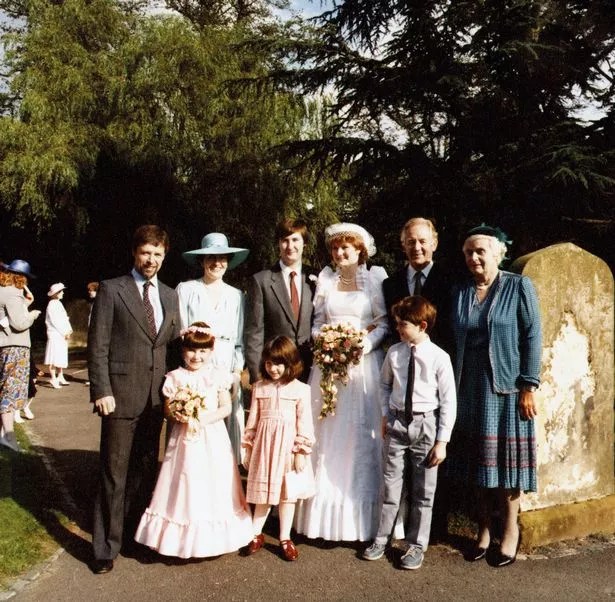
Peter Wright who is in the Yorkshire Vet -Alf was his mentor
All Creatures Great and Small The Historical Context of All Creatures Great and Small
Herriot’s writing in the All Creatures Great and Small shows the hardship of life during the Great Depression in England, while at the same time documenting a period of change for the veterinary industry (Rossi, 33). This contrast is characteristic of the Depression in England, with intense poverty and unemployment lines juxtaposed against new electricity, prosperity, and movie theaters (“History: The Depression of the 1930s”). All of these elements make an appearance in the novel, helping Herriot to set the scene of the times. Herriot paints a picture of a quaint, but difficult, time in Yorkshire history, when critical advances in technology and medicine were just appearing.
In the beginning of the book, Herriot comments that his veterinary friends are unable to get work, setting the scene for the bleakness of the Depression, “being a newly qualified veterinary surgeon in this year of 1937 was like taking out a ticket for the dole queue” (8). The dole queue evokes the image of the iconic line, seen in many pictures of Britain’s Great Depression, where unemployed people had to go to get government support. Poverty on the farms and in the villages is also quite apparent in Herriot’s writing. Herriot describes the Rudds in detail, and notes the clever way that Mrs. Rudd is able to sustain her large family in Chapter 53: “It puzzled me, too, how Mrs. Rudd, armed only with the milk cheque from Dick’s few shaggy cows, had managed to feed them all, never mind bring them to this state of physical perfection.” (334). Using the setting of the Depression, Herriot is able to emphasize the resilience of the farmers of the Dales.
This poverty contrasts with the great wealth at the time, and with the technological advances of radio, telephone, and electricity. The Great Depression paradoxically fueled a period where British society was more well-to-do: many more people could afford to have luxurious houses and other goods, due to the lowered prices of the period. This increase in disposable income led to veterinarians shifting focus from working with beasts of burden to pets such as cats and dogs. In the novel, Herriot still often works on livestock, but, because the narrator comes from a present-day (the 1960s) perspective, he is very aware that livestock is disappearing: “Nowadays the sight of a cart mare and foal in a field would make me pull up my car to have another look” (148). Herriot’s work with livestock is juxtaposed against his more luxurious work with pampered dogs, such as Tricki Woo, thus emphasizing that the small animal work in Yorkshire is increasing with to people’s wealth.
Herriot benefits from the technological advances of the 1930s in a variety of ways. In one example, he marvels “there was electricity in place of the usual smoke-blackened oil lamp” (357) while he is helping a cow give birth. Herriot also enjoys the luxury of being able to take Helen to the movie theater on their second date. Movie theaters—or cinemas, as they are called in England—were a huge technological advance at the time (“History: The Depression of the 1930s”). Furthermore, Herriot mentions that Siegfried has bedside telephones installed, remarking that “These bedside phones were undoubtedly an improvement” (184); despite the fact that they scare Herriot when they ring in the middle of the night, they offer a new level of comfort by allowing him to answer the phone from his bed.
The advances in technology were not the only advances of this period: the farming industry changed a great deal in the 1930s as well. With many ancient treatments being obliterated and new drugs being discovered and put into use, All Creatures Great and Small takes place during a changing period of veterinary medicine. One marked change, driven by the government health standards, was the increase in attention to eradicating tuberculosis in cows. The British government paid special attention to this in the 1930s: the agricultural decline after World War I, followed by the depression, had an effect on the health of cows, leading to milk contamination (Woods). This increased attention to tuberculosis is notable in Herriot’s work as an inspector, which involves testing cows for this disease.
Throughout the novel, Herriot contrasts the medicines of the 1930s with those he now uses in the 1960s (Rossi, 38). The medicines of Herriot’s present day were not yet known in the 1930s, as Herriot notes in his observation about the soon-to-be-obsolete Universal Cattle Medicine, described in Chapter 62: “The bottles were tall and shapely and they came in elegant white cartons, so much more impressive than the unobtrusive containers of the antibiotics and steroids which we use today” (400). Herriot’s narration allows the author to accurately illustrate the historical context of the book, while also painting a quaint picture the past in the imagery of the “…tall… shapely…elegant white cartons.” This helps to emphasize the changing landscape of veterinary medicine at the time, and keeps the reader engaged in a narrative that has a reminiscent tone of the old times.
All Creatures Great and Small Summary
All Creatures Great and Small is a book made up of a series of episodes that occur in the first two years of the veterinary practice of the protagonist, James Herriot. The plot is told through short anecdotes about treating animals, meeting farmers and other clients, and participating in the culture of the Dales. The overall plot follows the growth of Herriot’s career as a vet.
Herriot is hired as the assistant to the vet Siegfried Farnon. Siegfried has his veterinary practice in the town of Darrowby, in the Yorkshire Dales in England. Siegfried, Herriot, and Siegfried’s brother Tristan all live and work out of Skeldale House. The house is cared for by Mrs. Hall, who fixes them all their meals. Later, the character of Miss Harbottle also becomes a fixture in the house during the day, as the secretary for the veterinary practice, who is often at odds with Siegfried’s disorganized ways.
The plot of the novel is woven through Herriot’s various stories about the people and animals he meets in the Yorkshire Dales. He has varied experiences, often having to rush to farms in the middle of the night to tend to his patients. Gradually, the Dales farmers warm up to Herriot, and he appreciates them for their hospitality and resilience to the harshness of life in the Dales. Many of the farmers are accustomed to living with very few resources, and in very harsh conditions; the book is set during the Great Depression, when people often had to survive on very little. Herriot also encounters many wealthier clients, which provides a sharp contrast to the poverty-stricken farms he sees. Herriot tells the stories using humor, as he observes the laid-back pace of country life, the folk remedies the farmers believe in, and the diverse people he encounters.
While Herriot is struck by the beauty of the Dales, he also has a hard time adapting to the harsh weather in the winter. However, he does often take time to appreciate just how beautiful the snow is, even while his feet are freezing. The spring and summer in the Dales help to warm Herriot to the beauty of the countryside.
The book also contains various subplots that appear throughout the narrative. One subplot details the conflicts between Siegfried Farnon and Tristan Farnon due to their differences in temperament and personality. Herriot also enjoys moments of friendship with Tristan Farnon, who plays tricks on Herriot, gives him romantic advice, and brings him to village dances. In another subplot, Herriot tells humorous stories of an eccentric wealthy woman, Mrs. Pumphrey, and her beloved dog, Tricki Woo. As Tricki’s designated “Uncle,” Herriot receives expensive gifts from the dog and attends an elegant party on Tricki’s behalf, all of which he very much enjoys.
All Creatures Great and Small is a British television series made by the BBC and based on the books of the British veterinary surgeon Alf Wight, who wrote under the pseudonym James Herriot. The title aired over seven series, totalling 90 episodes, from 1978 to 1990.
Set in the Yorkshire Dales and beginning in the mid-1930s, it stars Christopher Timothy as Herriot, Robert Hardy as Siegfried Farnon (based on Donald Sinclair), the proprietor of the Skeldale House surgery, and Peter Davison as Siegfried’s “little brother”, Tristan (based on Brian Sinclair). Herriot’s wife, Helen (based on Joan Wight), was initially played by Carol Drinkwater and in the latter series by Lynda Bellingham.
The series was produced throughout its run by Bill Sellars. In early 1977, the BBC tasked him with the creation of a television series from Herriot’s first two novels, If Only They Could Talk (1970) and It Shouldn’t Happen to a Vet (1972), using the title of the 1975 film adaptation. It is part of a series of movies and television series based on Herriot’s novels. The Herriot novels were written in an episodic style, with each chapter generally containing a short story within the ongoing narrative of Herriot’s life. This format greatly facilitated their adaptation for a television series.
The series had two runs: the original (1978 to 1980, based directly on Herriot’s books) was for three series; the second (1988 to 1990, filmed with original scripts but generally regarded as a continuation of the 1978 series) for four. A total of ninety episodes was broadcast. The supporting cast, both recurring and one-offs, numbers over 600, most of whom appear as farmers or clients of the surgery.
Young James Herriot

One of British television’s best-loved characters returns to the screen with Young James Herriot, a new three-part drama series based on the early life of James Herriot, Britain’s best-loved vet.
Young James Herriot
Published: 25 November 2011
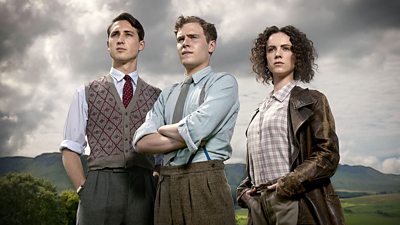
Iain de Caestecker (The Fades), Amy Manson (Outcasts), Ben Lloyd-Hughes (Miliband Of Brothers), Gary Lewis (Billy Elliot), and Tony Curran (The Pillars Of The Earth) star in this new BBC One drama produced by Koco Drama (a Shed Media company).
It’s more than 20 years since James Herriot was last on our screens in the much-loved and hugely successful All Creatures Great And Small. This new series is also inspired by Herriot’s best-selling books but this time the focus is on his early life as a student at Veterinary College in Glasgow.
The series draws on unprecedented exclusive access to an astonishing archive from veterinary surgeon Alf Wight, who wrote under the pseudonym James Herriot. This includes the diaries and case notes he kept during his student years, together with the authorised biography written by his son, Jim Wight.
The inspiration for the new series initially came from Johnny Byrne, a stalwart of British television whose credits included All Creatures Great And Small, Doctor Who and Space 1999 among others. As a script editor on the original series Byrne was convinced there were more stories to tell.
“Johnny was a great writer and he knew Alf and his family really well,” explains consultant producer Kate Croft.
“Through his friendship with Alf he also came to know this wonderful story of how Alf became a vet. This was an amazing story and when he first told me – this was about 10 years ago – I knew it had to be a TV series. I had loved all of the Herriot books and I just ate up the original series.”
Johnny Byrne’s passion for the idea and his years of experience as a writer convinced Croft that the series could succeed.
Croft took the idea to Shed Media in Glasgow who were equally excited about the project and began to develop the idea. Sadly Johnny Byrne died in 2008 while the show was still in development.
The most important aspect of the show was the cooperation of the Herriot estate and in particular Jim Wight who wrote his father’s biography. The family are justifiably proud of the Herriot legacy and very protective of his reputation. They still live in Thirsk in the heart of Herriot country and are actively involved with the Herriot museum.
This turned out to be a key factor as Jim Wight gives a lot of talks and is actively involved talking to people at the museum with his sister Rosie. One of the questions he is most frequently asked is how his father became a vet. He knew there was a fan base out there who were anxious to hear this new story. But the family do take their responsibilities very seriously.
Iain de Caestecker who plays the young James Herriot met the family and had dinner with Jim Wight.
“They were very helpful,” says de Caestecker. “They knew that I would want to be as protective of James Herriot’s memory as they are but they also understood that a lot of the content in this series is fictionalised. They also realised I had a job to do as an actor and appreciated that.”
The series is set in Glasgow Veterinary College in the 1930s, a time of great hardship for everyone and a time when it seemed that the practice of veterinary medicine was dying out through increased mechanisation.
Cameron Roach, executive producer, Shed Productions, says: “The Glasgow Veterinary College of 1933 is an inspired setting for this series. Whilst portraying the reality of the era, stories will be delivered with charm and humour taking James Herriot and his fellow student vets from the rural dairy farm to inner city slums, and to an aristocratic family seat. The series combines the authentic period detail of a time of huge social and political change with an outstanding ensemble cast.”
The series introduces us to an idealistic James Herriot newly arrived in Glasgow and ready to make his way in the world as a vet. The drama focuses on his relationship with his new found friends Whirly Tyson and Rob McAloon. The trio make their way through the college like a veterinary version of the Three Musketeers as Amy Manson explains.
“It is an extremely complementary relationship in that they all have different qualities that add up to a total package. Whirly and McAloon take James under their wing; McAloon is the joker, Whirly has the brains, and James has this compassion and heart. I think the way Iain has chosen to play James is terrific. It is absolutely spot on and I am sure audiences will be moved by his idealism and desire.”
The access that the production was given to the Herriot archive and the Vet School archive means that the period is recreated in loving and painstaking detail. But it’s not just the setting that should surprise audiences according to Kate Croft.
“Young James has a Scottish accent as Herriot himself did. Christopher Timothy didn’t play him with an accent at all but Alf grew up in Glasgow and retained a gentle West of Scotland accent. We were looking for a young Alf, not a young Christopher Timothy, and knew we had found our “James” when we saw Iain. I think Iain is a great find, not only is he a great upcoming Scottish actor but there was the added bonus that he grew up in the same part of Glasgow as Alf.
“Audiences should also be pleasantly surprised that this is not in a rolling, bucolic setting but in 1930s industrial Glasgow. There is lovely countryside nearby but the College is in town and we had a great picture archive to rely on to get the look right. The social attitudes of the time are another very important part of the show; Whirly is one of only two female students at the college which gave us another opportunity to show a different side of James.
“This is a very rich period with some very complex attitudes and we were able to mine those details.
If you don’t know the books you have a chance to get into this character, if you do then it’s a wonderful new story about the making of the man. His triumphs and disasters, the mistakes he made, and how he learned from them.”
 Nelle's journey