Peter O’Brien

Once again, I find myself exercised by the thoughts of vigorous Voice proponent Chris Kenny, prompted by a recent editorial in his Sky News program. I’m not sure why I bother. I know I’m not going to change his mind but, nevertheless…
KENNY: Now I haven’t done a lot on the Voice lately basically because the debate is so low-brow and toxic. On one side you’ve got the Yes case pushing for the constitutional recognition that Indigenous Australia has asked for, but with pretty ordinary advocacy hampered by their reluctance to say exactly how they’d implement it. And on the No side we just get relentless fearmongering.
Kenny used to say: ‘Let’s have the debate. I’m up for it’, or words to that effect. He doesn’t seem to say it much anymore because in the above grab, you have, essentially, the entirety of Kenny’s contribution to the big debate. So let me see if I can get something going here. I will make some observations and pose some questions throughout the remainder of Kenny’s editorial. To begin with, just because Indigenous Australia has asked for constitutional recognition, doesn’t mean it should automatically be granted, let alone in the form they demand. (There are arguments for and against, which I have canvassed here and here.)
KENNY: They say they support a legislated Voice, so they apparently agree that Indigenous people should have a say on laws and policies directed at them, but they oppose it being in the Constitution.
To begin with, not all Voice opponents support a legislated voice. I, for one, think it will very quickly morph into a huge self-serving bureaucracy that will have little effect at the grass roots level. But, even for those who do support a legislated Voice, there is no logical disconnect from opposing its inclusion in the Constitution. For one thing, opponents recognise that if a constitutional Voice becomes dysfunctional or outlives its purpose, getting rid of it will be much harder than if it were merely legislated. Tellingly, Voice proponents makes this point also. They want it in the Constitution for precisely that same reason – to put its existence beyond the reach of Parliament. Kenny may believe the Voice will always be benign and useful, and he can accuse opponents of being wrong when they argue the opposite, but he cannot accuse them of being illogical. That’s just Kenny being illogical.
Now we come to the question of ‘indigenous people’ having ‘a say on laws and policies directed at them’. Here’s my first question. Chris, your use of the words ‘directed at them’ – rather than ‘matters relating to’ them as the referendum questions is phrased – suggests you mean laws and policies that ‘uniquely affect’ Aborigines. That is, do you mean laws that only affect Aboriginal people, i.e., those laws enacted under Section 51(xxvi) of the Constitution? If so, would you agree that the current wording of the referendum questions allows a much broader remit than that, as, in fact, Voice supporter Professor Greg Craven has conceded? Does that remit sit comfortably with your view of the Voice? If not, would you agree that a caveat to the effect that this Voice only covers laws enacted under Section 51(xxvi) would be an improvement?
KENNY: So, all they do is run hysterical scares about how it will change everything. Even though all it can do is offer advice, which any government can ignore and even though the Parliament will re able to reform or reshape the body any way it likes.
‘All it can do is offer advice’ is Kenny’s fall-back position in response to any suggestion that a Voice might seek to wield executive power in its own right. I’m not saying it will be able to pass laws or dispense public funds, but, by virtue of being a separate chapter in the Constitution it will automatically achieve a constitutional status equivalent to the Commonwealth and the States. As an entity in the Constitution it will be subject to the jurisdiction of the High Court. That is, it will be, as both former Justice Ian Callinan and former Justice Kenneth Hayne have attested, justiciable.
Let me propose a scenario. A mining company wants to develop a strategically important mine in an area which is subject to native title. Let’s say the miner wants to extract rare earth minerals essential for the production of wind turbines and solar panels. The Voice objects on the grounds that the operation will desecrate a recently discovered sacred site, for example a hitherto unknown midden buried under a few feet of topsoil. The Labor/Greens government hears the objection but decides that the importance of this mine, as part of our contribution to saving the planet, outweighs the spiritual considerations of the local Aboriginal population. The Voice decides to appeal that decision to the High Court.
Is this scenario something you would see as improbable, Chris?
Let’s now imagine it was a Liberal government and the proposal was to construct a nuclear power station. How do you think the High Court that gave us Love/Thoms would rule on that? Yes, I accept that these things are happening already, e.g., the Barossa gas project in the Timor Sea. Do you think the Voice will be content to be passive bystander in this type of activism, or will it use every ounce of its Constitutional clout to join in the fun?
Of course, a legislated Voice could also litigate the matter, but an entity that has a right, guaranteed by the Constitution, not to give advice but to ‘make representations’ to the Government will carry considerably more weight than any other lobby group. Because Aboriginal rights, by virtue of them having been here first, transcend the rights of other Australians. By a process of lawfare, already well developed by green activists, they will be able to delay projects or legislation to such an extent that it will effectively amount to a veto. And why might they want to do that? Former High Court Justice Ian Callinan has suggested that it won’t be long before the Voice is infiltrated by the mainstream political parties, notably the Greens. Does that sound an unlikely prospect to you, Chris?
And, inevitably, it will be the government that funds them to conduct this litigation, as opposed to other lobby groups who must fund their own cases.
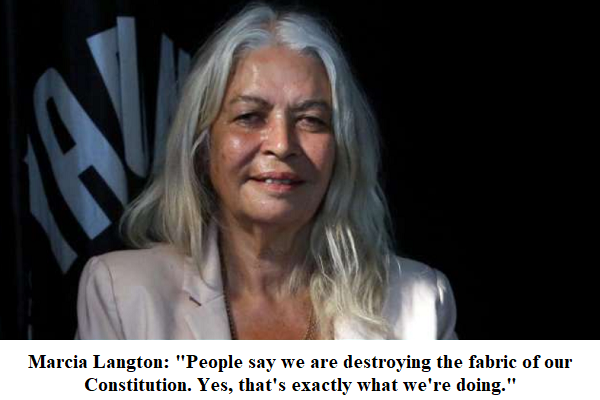
My next question to you, Chris, is when was the last time you heard Dr Marcia Langton or Dr Megan Davis or Thomas Mayo insist that the Voice will only be able to give advice and that the government will be able to ignore it with impunity? And, if it is intended that the Voice only be able to give non-binding advice, why is there not a caveat in the referendum wording to make this plain, to disarm what you call the ‘scare campaign’? Why does the wording say, ‘make representations’ rather than ‘give advice’?
And as to your complacent assumption that a responsible Parliament will ensure the Voice never exceeds your expectations of its acceptable remit, do you believe governments are immune from doing stupid things like conceding some degree of political power to this Voice? You spend a lot of time calling out stupid government decision injurious to our sovereignty – like signing up to Net Zero emissions, like killing our coal and gas industries, like allowing woke ideology to corrupt our education system, like removing TPVs, like imposing lockdowns and vaccination mandates. And yet you seem to think the most left-wing Labor government since Whitlam, in thrall to the even more crazy Greens, would not hesitate in a frenzy of virtue signalling to hand over some degree of power to noisy Aboriginal activists. That’s what is happening in Victoria, and have you noticed, Chris, what’s happening in Western Australia, where development must genuflect before Warnamankura, the water serpent spirit sacred to the Thalanyji people of the Pilbara. Do you believe a Liberal government would be resolute in reining in an out-of-control Voice? A party which, when in government, couldn’t even manage to abolish Section 18c of the Racial Discrimination Act? A party which in government, federally and at state level, has perpetrated or participated in all of the above outrages?
The aforementioned Dr Megan Davis is the co-author of the UN Declaration on the Rights of Indigenous Peoples, which was endorsed by the Rudd government in 2009. That endorsement has never been withdrawn so, arguably, it forms part of our common law. Article 19 of that Declaration states
States shall consult and cooperate in good faith with the indigenous peoples concerned through their own representative institutions in order to obtain their free, prior and informed consent before adopting and implementing legislative or administrative measures that may affect them.
Chris, would you think it beyond the bounds of possibility that activists might argue to the High Court that a Constitutionally entrenched Voice (absent any caveat that it is advisory only) is a genuine ‘representative institution’ through which the veto explicit in Article 19 might be implemented? And would you think it beyond the bounds of possibility that the High Court might accept that argument, particularly if the UN Declaration were legislated into statutes, as is the policy of the Greens and, I would think, many of the Labor caucus as well?
Let’s continue:
KENNY: And the hard-heartedness, for want of a better word, of the No campaign has been revealed by something one of its committee members, the former Keating Labor government Minister, Gary Johns, has published in the past. In his book, The Burden of Culture, Johns, to be fair, raises some good points and some courageous ideas but he also shows a deep resentment towards Indigenous initiatives. He rails against this Welcome to Country, for instance, and any special programs or categories for Indigenous people and, controversially, calls for proof of indigeneity.
As to Gary Johns ‘railing’ against things (i.e., complaining angrily or emotively), use of this term cheapens your argument, Chris. Johns would not be alone in resenting the constant welcomes to country and the acknowledgements of elders (generally repeated by each and every speaker at an event) or the unilateral renaming of major cities or the myriad of other slights to which mainstream Australia is now subject. But he doesn’t do it angrily. As to his attitude towards special programs, I think you overstate the case. Johns merely maintains that any special benefits should be based only on merit and need. Let’s return to proof of identity.
KENNY: At the moment we use a three-part test. It’s well understood by governments and other authorities. You’re indigenous if you’re descended from other Indigenous people, you identify as Indigenous and you are accepted by an Indigenous community.
And how effective is that test, Chris? It seems Uncle Professor Bruce Pascoe passes that test even though all the evidence suggests he fails at the first, and I would have thought fundamental, hurdle – being descended from other Aboriginal people. Roger Karge, from Dark Emu Exposed, has done a huge amount of work in smoking out frauds – mostly politicians and aspiring politicians – at the behest of Aboriginal organisations. It seems Aboriginality is catnip to aspiring politicians.
Dr Suzanne Ingram, herself an Aboriginal academic, estimates that as many as 300,000 of the 800,000 odd Aboriginal population, aren’t genuine. In October last year, you interviewed Nathan Moran, CEO of the Metropolitan Indigenous Land Council, who stated emphatically, citing examples, that there had been massive fraud. He stated that this was a problem that must be addressed. How would you suggest that problem might begin to be addressed?
KENNY: But Johns wants more. ‘It is possible to test Aboriginal lineage’, writes Johns. ‘If the current three-part test on Aboriginality is to remain, then just as Aborigines insist in native title claims, blood will have to be measured for all benefits and jobs’. Now this is pretty odious stuff, completely unnecessary and underpinned by some sort of resentment as if being Aboriginal is a rort. I mean it really downplays the disadvantage that most Australians are keen to overcome in this country. And this talk of blood test, it harks back to the old official racism in this country, the references to full-bloods and half-castes and quarter-castes. I thought we’d gone beyond that sort of attitude, that focus on race.
Is not Gary Johns merely making the same point that Dr Ingram and Nathan Moran are making? Are they espousing ‘odious’ views? In fact, this question of Aboriginality is, or should be, at the heart of this referendum debate. I quote from my book The Indigenous Voice to Parliament? The No Case:
A provision in the Constitution that references, or rather preferences, a certain group of people must make it beyond doubt who those people are. If the current criterion – self-identification – is applied, that would open up a can of worms. We need to know exactly who qualifies as an Aborigine and how those persons establish their bona fides. For example, would any degree of Aboriginality in one’s ancestry qualify? If so, then the Aboriginal population can only continue to expand indefinitely, to the point where this will become less and less about disadvantage and more and more about entitlement. If not, then where is the cut-off? 50 per cent Aboriginality? 25 per cent? 12.5 per cent? Wherever the benchmark it is set, someone is going to be aggrieved. If this issue is not adequately addressed in the referendum question, that alone should be a deal-breaker.
I cannot stress this enough. It cannot be left to Parliament, or worse, the High Court, to define, expand or contract this demographic at whim. If the Voice goes into the Constitution, then it must be the Constitution (by means of a referendum) that defines and redefines – over time and as necessary – who is an Aborigine.
KENNY: I keep saying this is not about race.
The fact that you keep saying it doesn’t make it right. Puts me in mind of a famous Monty Python sketch. If it’s about ancestry and who was here first, then the unavoidable fact of the matter is that members of only one race may aspire to vote for or sit on this Voice. It is possible that a white man, living in Mosman and married to a woman whose great-great grandmother was an Aboriginal woman, will father a child who will be able to sit on the Voice but his/her father may not. And even though he/she may never have lived the life of an Aborigine.
KENNY: This is about Indigenous Australians, recognising them in a practical way, supporting their aspirations and hopefully delivering permanent reconciliation in this country.
What is reconciliation, Chris? How will we know it when we achieve it? When Aborigines tell us we’re reconciled? I’ll tell you when that will be, Chris. It will be when they have got a treaty, truth-telling (whatever that is) commission, reparations and some form of sovereignty. That is what the Uluru Statement demands. And you tell us this Voice isn’t about those things?
If the Voice is to help deliver reconciliation, it must be as the enabling step for these other demands. Langton, Davis, Mayo & Co are telling us that, but you choose not to listen.
KENNY: All this talk of race and division from the No side is, well, it’s racially divisive. Here’s Gary Johns in the previous hour with Andrew Bolt: ‘How do you measure descent in a culture that doesn’t have a written record often. You have to prove it by blood or, now, DNA tests. So, if you want to have a race-based system, whereby you get benefits because of your ancestry, then, at some stage you have to measure’. You know I’ve interviewed Gary Johns in the past and have some respect for him, but his hard attitudes on this topic are pretty revealing and disturbing. There are no tricks in the Voice idea, no-one is getting a free lunch, and no-one is losing anything.
Well, according to Nathan Moran, plenty of fauxborigines are getting a free lunch and people genuinely entitled to these benefits are losing. As is the Australian taxpayer. Johns is doing nothing more than proposing a rigorous method to solve a problem identified by many Aboriginal people.
KENNY: There’s nothing to be resentful about. It’s about having a country a typical indigenous baby is born into pretty much the same hopes and dreams as a typical non-indigenous kid. That’s why the No case should put their scare campaigns away and deal a little more in the facts. I mean the idea that heritage laws in WA or the push to shift Australia Day or push for a treaty are a taste of things to come with the Voice, just don’t make any sense. They’re all happening now without a Voice.
Not a great zinger, Chris. No campaigners don’t say the Voice will cause these things, merely that they are a portent of things to come at a national level. Here’s another question for you Chris, to which I’ve never been able to get an answer. Do you think truth-telling, treaty, reparations, and some form of joint sovereignty are desirable outcomes on the road to ‘reconciliation’? If you do, then your support for the Voice is understandable. And, if you don’t, then why do you think people associating these issues with the Voice, given that Anthony Albanese has promised to implement the Uluru Statement in full, is just fear mongering rather than a healthy reaction to what we are being told by the architects of the Voice?
Here is my final series of questions for you, Chris. You say the debate is “low-brow and toxic”. Would you concede that a proposal to insert a new chapter in the Constitution demands a rigorous examination of any, and all, possible unintended consequences? Would you concede that, in changing the Constitution, we should err on the side of caution, especially given that the practical outcome you champion (rather than the symbolic one of ‘recognition’) can be achieved through legislation? Would you concede that dismissing your Sky News and News Corp colleagues, folks at the IPA, Jacinta Price and Warren Mundine, plus writers at The Spectator and Quadrant as fearmongers is tantamount to calling them deceptive, even racist? And would you say describing the views of someone, who has proposed a rigorous, practical and safe way to solve a burgeoning problem, as ‘odious’, is toxic or merely low brow?
KENNY: A Voice is a way to get better grass roots representatives and smarter debates and ideas, hopefully, not the opposite. The status quo has been a disaster. Surely everyone can see that. And that’s why the Yes case needs to get its act together ad explain their case in stronger, clearer terms.
We will have to agree to disagree on this point, Chris, but the fact that the status quo has been a disaster (at least for the 20 per cent of Aborigines have not transitioned into the modern economy) is true. But the status quo has its genesis in the policies of self-determination put in place by Nugget Coombs to replace the policies of assimilation favoured by Sir Paul Hasluck, during whose tenure advancement of Aborigines, at least in terms of physical and material well-being, seemed to be on track.
This Voice looks like just another layer of status quo bureaucracy to me.
 Nelle's journey