Aussie History
Hi all,
At the age of 16, Jack arrived in Sydney in 1854, he then made his way to near Omeo in the Victorian high country to live with his sister at the busy gold mining area of Cassilis.
He worked for a time as a tailor in a clothing shop in Omeo, his love however was elsewhere. He spent all his spare time around horses, even braking in some of the wild bush brumbies. In time he became a full time stockman and for a number of years spent a good part of each year in the high country, around the Snowy River and the Victorian and New South Wales border. Several times a year he would return to Omeo to replenish his supplies and catch up with his sister’s family and his friends.
In 1884 at the age of 46 he was given a management role supervising cattle in the high country over the summer months, he would then muster the animals and work them down from the mountains to the home paddocks before winter. Right from the start his reputation was further enhanced, in time they became legendary as time and time again he proved himself to be a fearless rider and a first-class handler of stock.
In the late 1880s,”Banjo” Paterson, stayed the night with Jack at his hut on Tom Groggin Station. Over a shared bottle of whisky one evening, Jack told his visitor several of his experiences as a stock man in the high country. It is believed that one particular story about an exciting horse chase through many hazards, where “the wild hop scrub grew thickly and the hidden ground was full of wombat holes, and any slip was death”, gave birth to Banjo’s now famous poem, “The Man from Snowy River”.
It was a lifestyle that he relished and as the years passed, his love and knowledge of the high country grew. His high country home was a simple timber hut and despite living on his own for nearly thirty years, he was not averse to visitors and was better known than probably any other man in the mountains at that time. He was a friendly generous person liked and respected by all who knew him.
The final stage of his life occurred in the winter of 1914, by then in his mid seventies, he still lived alone in his hut surrounded by the high mountains and the country he loved. Word reached friends near Corryong that Jack was seriously ill and his mates decided to help him get to the Corryong Hospital.
On arriving at his hut they realised he was in a bad way, they immediately strapped him to a stretcher and began the slow and arduous task of carrying him on foot, back to Corryong. The track was a narrow and rugged bush trail which followed in parts the Murray River and in others it climbed over rugged spurs. One in particular was nearly 2,000 feet high, it was covered in thick scrub, rocks and boulders and to make matters worse that day, it had began to snow.
(For anyone who doesn’t know that country, the track from Tom Groggin to Corryong would have had to traverse some of the most rugged, hard to penetrate country there is in the Alps, the trail would have been just about as tough as it gets).
They soon realised they had to act fast, Jack’s half unconscious body was placed onto the back of one of the horses and with his friends supporting him as best they could, they continued the climb. After many difficulties they eventually made their way to a hut at the junction of Surveyor’s Creek and the Murray River. As night set in it continued to snow and drizzle, all being thankful for having some protection that evening. Jack’s condition worsened so one of his friends set off towards Corryong to get further help while the others tried to make him as comfortable as possible for the night.
(Again such an effort would have had to be undertaken to get to Corryong from there, plus it was dark, and snowing, absolutely amazing).
Jack rallied a little and spoke a few words to his friends but soon after died. Instead of burying him there, as was the norm in those days, his friends felt he was worthy of something better than what they could provide at that remote spot. The next day his mates with a heavy heart, carried his body back into Corryong.
Knowing the history of the man, (and the country where he lived) it was far better for him to pass away out in the sticks so to speak, surrounded by his much loved country (and his mates) instead of passing away in a hospital ward of some sort.
There has been some conjecture over the years, whether Jack was indeed the “Man”, but most historians do believe that he was or indeed epitomised all that “Banjo” wrote about.
Rest in peace Jack, “The Man From Snowy River”
Col.

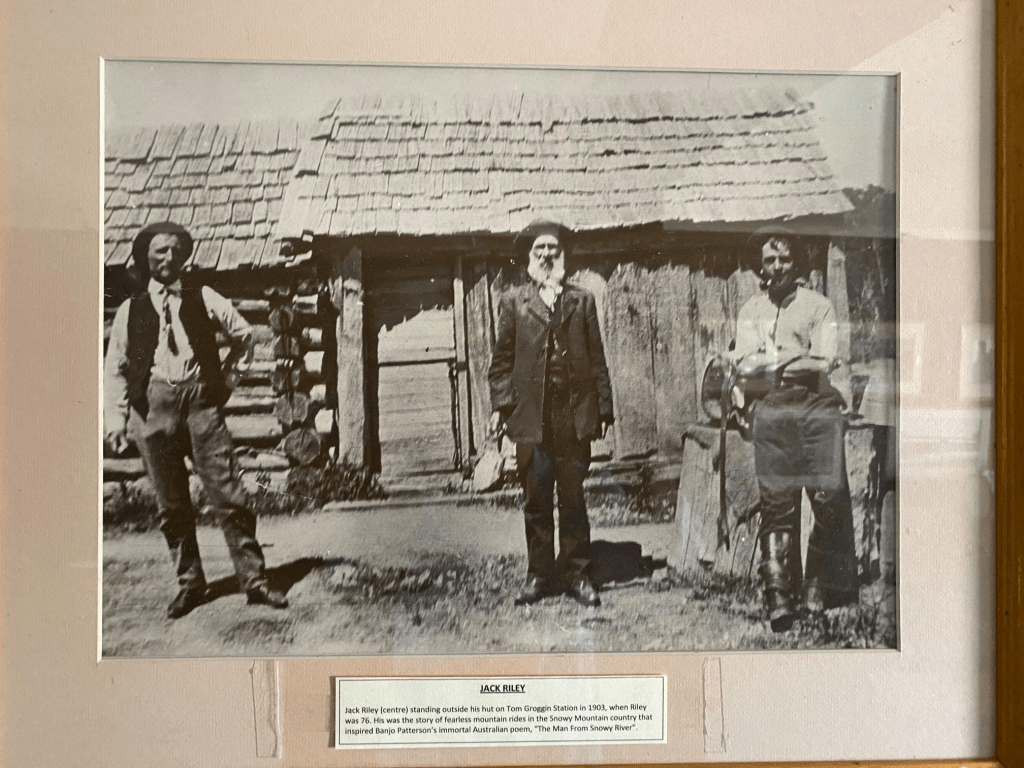
Jack in the middle, standing outside his cabin/hut on Tom Groggin Station. The dates on the blurb under the photo are wrong, Jack was 76 in 1914 when he died.
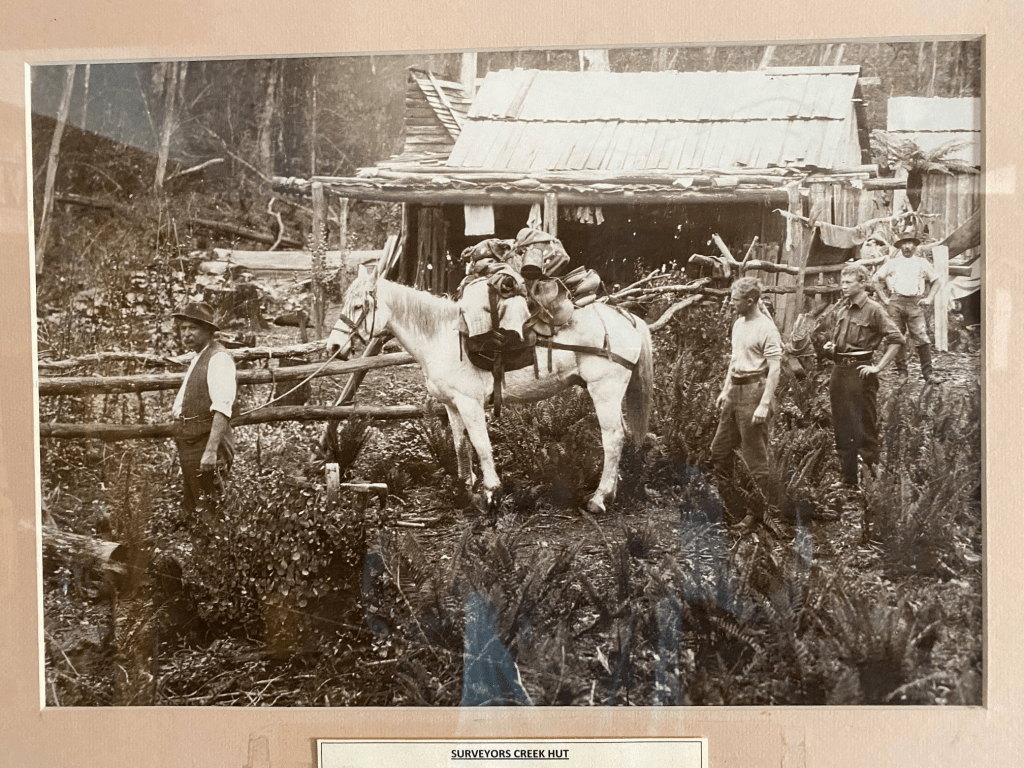
Surveyors Creek hut where Jack passed away. It is near the junction of the Creek and the Murray River. The photo is believed to be from around the time Jack died.
 Nelle's journey